Frenzel Equalization Explained Simply
Your ears do not care how long you can hold your breath. They do not care about your technique, your fitness, or your fin kick. Every freediver, from a first timer to a national champion, has to solve the same problem on every single dive: getting air into the middle ear fast enough to keep up with the increasing water pressure.
Frenzel equalization is how you solve it. It is the technique that separates freedivers who plateau at 10 meters from those who comfortably reach 30 and beyond. If you have tried equalizing by pinching your nose and blowing hard, you have already felt the limits of the alternative. Frenzel is different. It is precise, efficient, and once you learn it, you will never go back.
This guide breaks down exactly how Frenzel equalization works, how it differs from the technique you probably already know, and how to start practicing today before you ever get in the water.
What Frenzel Equalization Is and Why It Matters
Frenzel equalization is a method of sending air into your middle ear using your tongue as a piston. You trap a small pocket of air in your mouth, seal off your lungs by closing the glottis (the valve at the back of your throat), and use your tongue to compress that air upward through your Eustachian tubes into your ears.
The result is a gentle click or pop in both ears as the pressure inside your middle ear matches the water pressure outside. You do this every 1 to 2 meters during a freedive, and each equalization takes less than a second.
Why does this matter? Because without equalization, water pressure pushes inward on your eardrums as you descend. At 10 meters depth, the pressure on your body is double what it is at the surface. Your lungs compress naturally to handle this. Your ears do not. If you descend without actively sending air into your middle ear, you feel pain at around 3 to 5 meters and risk a barotrauma (ear injury from pressure) shortly after.
Frenzel equalization is the standard technique taught in freediving courses worldwide because it works reliably to 25 to 30 meters, uses minimal energy, and keeps the rest of your body completely relaxed during the dive. For a broader overview of equalization in freediving, read our guide to equalization for freedivers.
How Frenzel Differs from Valsalva
If you have done scuba diving, you learned the Valsalva maneuver. Pinch your nose, close your mouth, and blow. Air pressure from your lungs forces open the Eustachian tubes and your ears pop. Simple, effective, and perfectly adequate for scuba diving where you have an unlimited air supply and descend slowly.
Frenzel equalization works on a completely different principle. Here is what separates the two techniques.
Where the Air Comes From
Valsalva pushes air from the lungs. You engage your chest and abdominal muscles to create pressure, and that pressure travels up through your throat and into your ears. Frenzel uses air that is already in your mouth and throat. Your lungs are not involved at all. The air supply is isolated above a closed glottis, and your tongue does all the compression work.
What Happens at Depth
This difference becomes critical as you go deeper. As water pressure increases during a descent, your lungs compress. At 10 meters they are half their surface volume. At 30 meters they are one quarter. By the time you reach 20 to 25 meters, your compressed lungs simply cannot generate enough air pressure for a Valsalva to work. You hit a wall.
Frenzel does not depend on lung volume. The small pocket of air in your mouth is all you need, and your tongue can compress it effectively regardless of what is happening in your chest. This is why Frenzel equalization works to depths where Valsalva completely fails.
The Tension Problem
Valsalva requires effort. You are bearing down with your core muscles, creating whole body tension, and raising your heart rate slightly with each equalization. In scuba, this barely matters. In freediving, where relaxation directly determines how long your oxygen lasts, that tension adds up across dozens of equalizations during a single dive.
Frenzel keeps your body relaxed. The only muscles working are in your tongue and soft palate. Your chest stays passive, your heart rate stays low, and your oxygen consumption stays minimal. This is a fundamental advantage that compounds with every meter of depth.
The Mechanics: Tongue, Soft Palate, and Glottis
Frenzel equalization involves three anatomical structures working together. Understanding each one makes the technique much easier to learn.
The Glottis
The glottis is a valve at the base of your throat, formed by your vocal cords. You use it constantly without thinking about it. Every time you grunt, cough, or hold your breath while lifting something heavy, your glottis closes.
In Frenzel equalization, the glottis acts as a seal. When you close it, you separate the air in your mouth and throat from the air in your lungs. This creates an isolated pocket of air that your tongue can pressurize without involving any chest effort. Think of it as closing a door between two rooms. The air above the door (in your mouth) is what you work with. The air below (in your lungs) stays untouched.
The Soft Palate
The soft palate is the fleshy tissue at the back roof of your mouth. You can feel it with your tongue if you slide backward past the hard bony ridge. During Frenzel equalization, the soft palate needs to be in a neutral or slightly open position so that compressed air from your mouth can travel upward into the nasal cavity and from there into the Eustachian tubes.
Some people unconsciously tense or close their soft palate during equalization attempts, which blocks the air path completely. If you can feel air moving through your nose when you do the tongue piston motion (while your nostrils are open), your soft palate is in the right position. If nothing moves, your soft palate might be sealed shut and you need to consciously relax it.
The Tongue
Your tongue is the engine of Frenzel equalization. Specifically, the back of your tongue acts as a piston that compresses air upward against the roof of your mouth. The motion is similar to saying the letter "T" or "K" forcefully, but instead of releasing the sound, you hold the pressure and direct it toward your ears.
Picture a syringe. The barrel of the syringe is your mouth and throat. The plunger is the back of your tongue. When you push the plunger forward and upward, the air in the barrel has nowhere to go except through the Eustachian tubes into your middle ear. That is Frenzel in a single image.
How to Learn Frenzel Equalization: Dry Practice
You can and should learn Frenzel equalization on land before you attempt it in the water. These exercises build the muscle memory you need so that equalizing during a dive becomes automatic rather than something you have to think about.
Exercise 1: Isolate Your Glottis
Say the letter "K" out loud. Notice where the back of your tongue hits the roof of your mouth. Now say "K" but stop at the moment of contact, before you release the sound. Hold that position for a few seconds. You have just closed your glottis.
Another approach: try to exhale gently with both your mouth and nose closed. Feel the pressure build at the base of your throat. That blockage is your glottis doing its job. Practice opening and closing it deliberately. Do 20 repetitions, holding each closure for 2 to 3 seconds. The goal is to close your glottis on command without any other muscles tensing up.
Exercise 2: The Tongue Piston
Puff your cheeks full of air. Close your glottis (as you just practiced). Now, with your lips sealed and glottis locked, push the back of your tongue upward and forward against the roof of your mouth. You should feel your cheeks deflate slightly as the air compresses.
Release your tongue and let your cheeks puff back out. Repeat this 10 to 15 times. This is the core motion of Frenzel equalization. You are training your tongue to move air independently of your lungs. If your cheeks are not deflating, either your glottis is open (air is escaping to your lungs) or your tongue is not generating enough compression. Check both.
Exercise 3: Equalize on Land
Pinch your nose with your fingers. Puff your cheeks with air. Close your glottis. Push with your tongue. You should hear or feel a pop or click in one or both ears. That pop is air entering your middle ear through the Eustachian tubes. That is equalization.
If only one ear pops, tilt your head so the silent ear faces upward and try again. Asymmetric equalization is extremely common, especially when you are starting out, and it usually resolves with consistent practice.
Exercise 4: Rapid Repetitions
Pinch your nose and equalize 5 to 8 times in a row without taking a new breath. Each equalization should use the tongue piston motion only. This simulates what you will do during a real descent, where you equalize continuously every 1 to 2 meters without pausing.
This exercise also helps you gauge how much air you consume per equalization. If you run out of air after 3 or 4 repetitions, you are probably leaking air through your glottis or using too much tongue displacement. The motion should be small and efficient. You are pushing a tiny amount of air into a tiny space.
Exercise 5: Head Down Practice
Once you can equalize consistently while sitting upright, try it while bending forward at the waist so your head is below your heart. This simulates the head down position of a freedive, which changes the dynamics of equalization slightly. Some people find that gravity helps air reach the Eustachian tubes in this position. Others find it harder because blood flow to the head increases tissue congestion. Practice both orientations so nothing surprises you in the water.
Aim for 10 minutes of daily practice in the week before your freediving course. By the time you arrive, the mechanical motion will be automatic and your instructor can focus on fine tuning your technique rather than teaching the basics from scratch.
Common Mistakes and How to Fix Them
Nearly every freediver struggles with Frenzel equalization at first. The mistakes are predictable and the fixes are straightforward.
Using Chest Pressure Instead of Tongue
The most common mistake is performing a Valsalva while thinking you are doing a Frenzel. If your chest tightens or your abdominal muscles engage during equalization, you are using lung pressure, not tongue pressure. The test is simple: equalize while someone places their hand on your stomach. If they feel any contraction, you are still using Valsalva. Reset. Close the glottis firmly, relax your chest completely, and use only your tongue.
Forgetting to Close the Glottis
If your glottis is open during the tongue piston motion, air escapes downward into your lungs instead of upward into your ears. You feel like you are doing something, but nothing happens in your ears. The fix: before each equalization attempt, consciously close your glottis first. Make it the first step every time. Close, then push. With practice, the closure becomes automatic and happens simultaneously with the tongue motion.
Running Out of Air in the Mouth
Each Frenzel equalization uses a small amount of air from your oral cavity. Over the course of a 20 meter descent (roughly 10 to 15 equalizations), you can deplete that air supply. The solution is to start your dive with your cheeks puffed with air. Some freedivers take a slightly larger than normal final breath and pack a bit of extra air into their cheeks before the duck dive. This gives you a larger reservoir to work with throughout the descent.
Tensing the Soft Palate
If you are performing the tongue piston correctly and your glottis is closed but air still is not reaching your ears, your soft palate may be blocking the pathway. Try yawning gently. Notice how the back of your throat opens and your soft palate lifts. That open position is what you want during equalization. Some instructors teach students to make a "guh" sound (without voicing it) to find the right soft palate position.
Equalizing Too Late
This is not a technique error but a timing error, and it causes more failed dives than any mechanical mistake. Many beginners wait until they feel pressure in their ears before equalizing. By that point, the Eustachian tubes are already compressed by the surrounding pressure, making them harder to open. The fix is to equalize early and often. Start at the surface before your duck dive, equalize again immediately as you begin descending, and continue every meter for the first 10 meters. Stay ahead of the pressure instead of chasing it.
When You Need Frenzel: Depth Thresholds
The physics of equalization change with depth, and understanding those changes explains exactly why Frenzel becomes necessary.
The First 10 Meters
At the surface you are at 1 atmosphere. At 10 meters you are at 2 atmospheres. The first 10 meters compress your air spaces by 50 percent, the largest proportional change of the entire dive. This is why the first 10 meters demand the most frequent equalization, roughly every meter.
During this shallow phase, both Valsalva and Frenzel work. Your lungs still have plenty of volume for Valsalva, and you have plenty of air in your mouth for Frenzel. Many beginners get away with Valsalva in their first few dives because they are not going deep enough to expose its limitations.
10 to 20 Meters
Between 10 and 20 meters, your lungs have compressed to between half and one third of their surface volume. Generating enough chest pressure for a Valsalva equalization becomes noticeably harder. You might need to blow harder, which creates tension. You might find that one ear equalizes but the other resists. These are signs that Valsalva is reaching its limit.
Frenzel works exactly the same at 15 meters as it does at 5 meters because it does not depend on lung volume. This is the depth range where the advantage of Frenzel equalization becomes obvious.
Below 20 Meters
Below 20 to 25 meters, most freedivers cannot generate enough lung pressure for a Valsalva equalization. The lungs are too compressed. If Valsalva is your only technique, this is your depth ceiling regardless of how good your breath hold or technique might be.
Frenzel continues working to approximately 25 to 30 meters for most divers. Beyond that, even the air in your mouth compresses to a volume too small for the tongue piston to work effectively. At that point, you need the mouthfill technique, which is taught in the Advanced Freediving Course. Mouthfill is essentially an extension of Frenzel where you fill your entire oral cavity with air at around 15 to 20 meters and use that stored volume for all remaining equalizations during the descent.
How We Teach Frenzel in Koh Samui
Reading about Frenzel equalization gives you the theory. Practicing the dry exercises builds the muscle memory. But the technique truly clicks when an instructor watches you equalize in real time and gives you immediate feedback.
In the Beginner Freediving Course on Koh Samui, equalization training starts on Day 1 before you touch the water. Your instructor demonstrates the anatomy, walks you through each dry exercise, and checks that you can produce the tongue piston motion and hear the pop in your ears. Every student gets individual attention because there are never more than 3 students per instructor.
On Day 1 in confined water, you practice equalizing at shallow depths of 2 to 5 meters while your instructor watches from alongside you. This is where the common mistakes surface. Maybe you are using chest pressure without realizing it. Maybe one Eustachian tube is sluggish and needs a specific head position to open. Maybe your timing is off and you are waiting too long between equalizations. All of these issues are diagnosable and fixable in a small group setting where your instructor has time to work with you individually.
By Day 2, you move to open water and begin descending along a line to 10, 15, and eventually 20 meters. Your instructor descends alongside you, watching your equalization at every depth. If you struggle at a particular depth, they stop you, bring you back up, and troubleshoot the issue before you attempt it again. There is no pressure to hit a number. You descend as deep as your equalization allows, cleanly and without force.
Day 3 takes you to Sail Rock or another open water site around Koh Samui, where you apply everything you have learned at a real dive site with real marine life around you. By this point, most students equalize without conscious thought. The tongue piston fires automatically every meter or two, and the focus shifts to the experience of the dive itself.
For certified freedivers who want to refine their Frenzel or transition to mouthfill for deeper dives, the Advanced Freediving Course picks up where the beginner course leaves off. You also have the option of booking fun dives with coaching for personalized depth training at Sail Rock.
Start Practicing Before You Arrive
Frenzel equalization is a motor skill. Like any motor skill, it improves with repetition. If you have a freediving course booked in Koh Samui, start the dry exercises today. Ten minutes a day for one week will put you significantly ahead of someone who shows up on Day 1 having never attempted the technique.
Practice the glottis isolation, the tongue piston, and the pinch and equalize exercise until you can pop both ears reliably 5 to 8 times in a row. Practice with your head upright and head down. When you arrive for your course, tell your instructor what you have been working on and where you are getting stuck. That conversation saves time and lets your instructor customize the training to your specific needs from the very first session.
Ready to learn Frenzel equalization with hands on instruction? The Beginner Freediving Course runs every Monday to Wednesday with a maximum of 3 students. Send us a message on WhatsApp to check dates and availability.
About Diego Pauel
Diego has been teaching freediving from Koh Samui since 2021. He holds instructor certification from Apnea Total and additional credentials across six certification bodies: Oxygen Advantage, Breatheology, International Breathwork Foundation (IBF), Breathing Cold, and GPBA. Plus emergency oxygen administration and first aid.
Learn More →Ready to try freediving?
Message Diego on WhatsApp to check availability for your dates. No deposit needed.
Check Availability on WhatsAppContinue reading
The Freediving Duck Dive: How to Get Under the Surface Without Wasting Energy
The duck dive is the first thing every freediver gets wrong and the easiest thing to fix. Here is exactly how to drop un
Read More →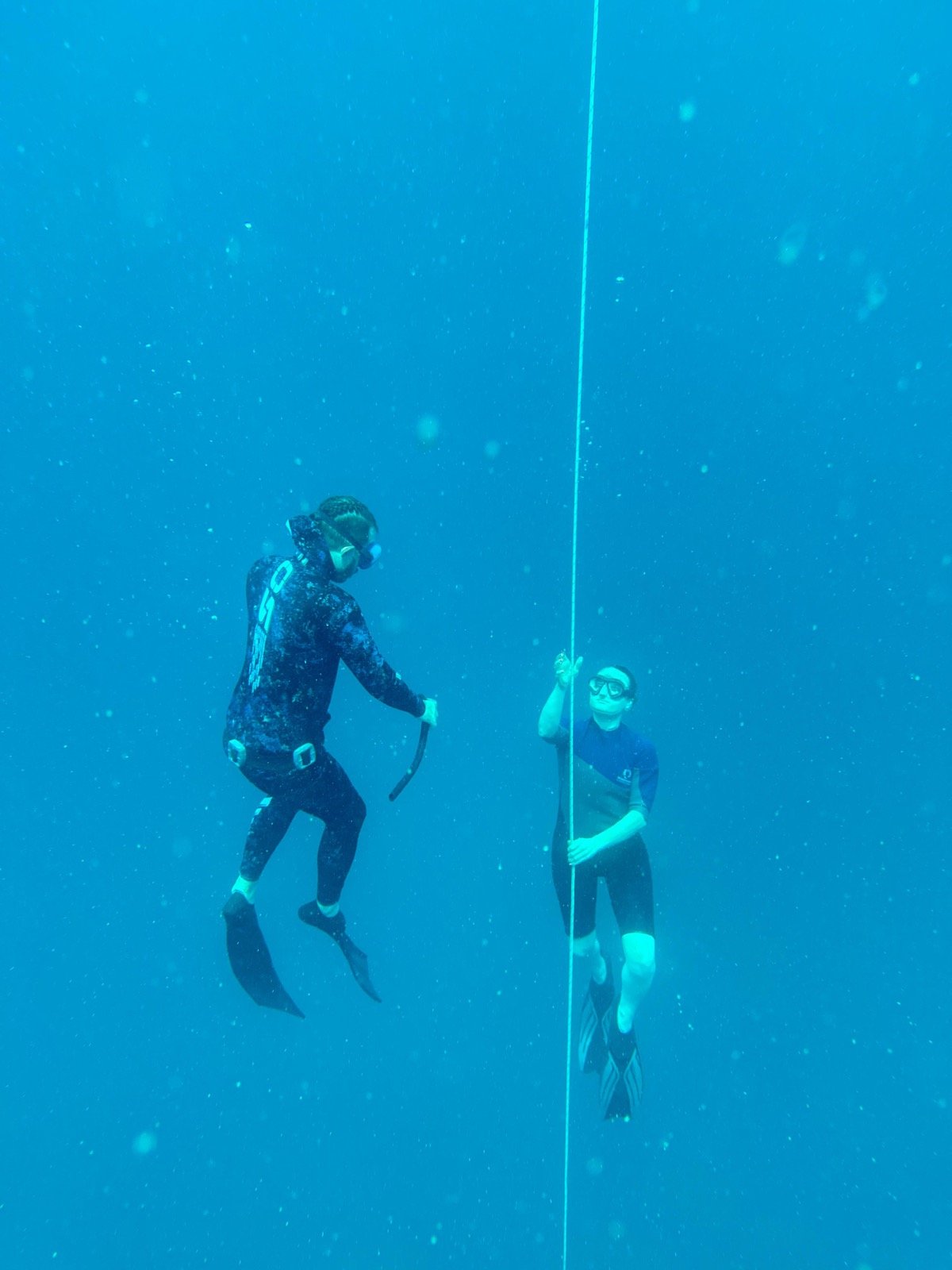
Freediving Finning Technique: How to Kick From the Hip and Stop Wasting Oxygen
Most beginners burn through their breath hold by kicking wrong — bending the knees, kicking too hard, and fighting the
Read More →