Whale Shark Freediving at Sail Rock: The Ultimate Guide
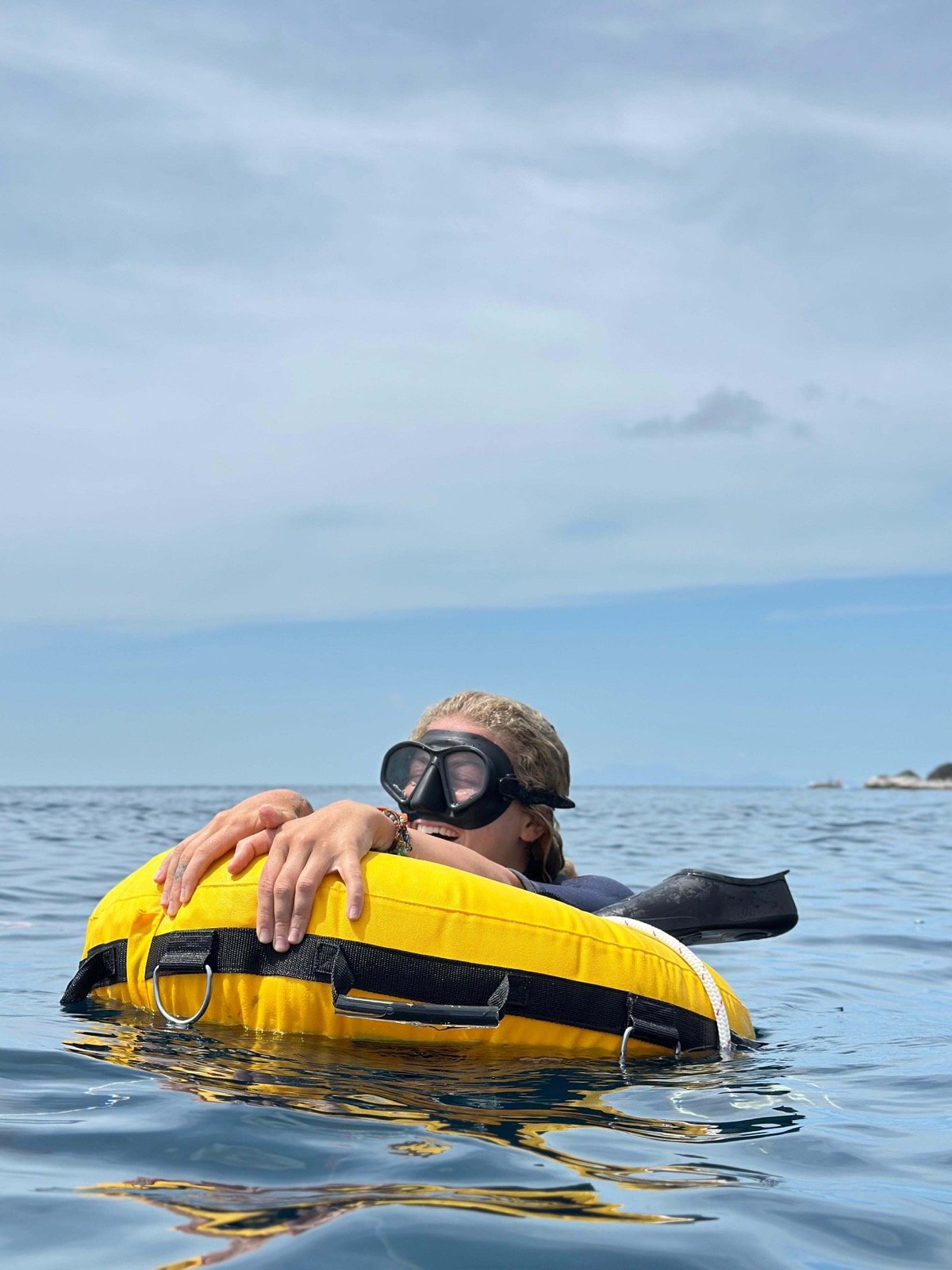
There is a pinnacle rock in the middle of the Gulf of Thailand where whale sharks feed every year between March and May. It is called Sail Rock. And the best way to experience it is not on scuba. It is on a single breath.
Whale shark freediving at Sail Rock is one of those experiences that sounds like it requires a remote expedition, expensive liveaboard, or military level logistics. It does not. Sail Rock is a 90 minute boat ride from Koh Samui. You leave in the morning and you are back by lunchtime. The water is 29 degrees. The whale sharks are 4 to 10 meters long. And you meet them in silence.
What Is Sail Rock
Sail Rock is a submerged granite pinnacle that rises from 40 meters depth to just above the surface of the Gulf of Thailand. It sits roughly between Koh Phangan and Koh Tao, about 20 kilometers offshore from either island. The rock gets its name from the single slab of granite that breaks the surface, visible from boats as they approach.
Below the waterline, Sail Rock is a vertical tower of marine life. The pinnacle creates an upwelling of nutrient rich water that attracts everything from clouds of fusiliers and batfish to massive barracuda schools, trevally, giant grouper, and between March and May, whale sharks. A vertical chimney, a natural swim-through, drops from about 5 meters to 18 meters through the center of the rock.
Sail Rock is widely considered the best dive site in the Gulf of Thailand. Most dive magazines and experienced divers in the region will tell you the same thing. What fewer people know is that it is closer to Koh Samui than to Koh Tao. Boats from Samui arrive before the Koh Tao dive boat convoys, which means quieter water and undisturbed marine life in the early morning.
Whale Shark Season at Sail Rock
Whale sharks visit Sail Rock between March and May, with April being the peak month. Sightings have been recorded as early as February and as late as June, but the three month window from March to May is when encounter rates are highest.
The whale sharks follow plankton blooms through the Gulf of Thailand. Sail Rock sits in the path of these plankton concentrations during the warm season. The same oceanographic conditions that produce the best visibility of the year, calm seas and warm surface temperatures, also attract the largest fish in the ocean.
In a productive April week, multiple whale shark sightings at Sail Rock are common. In a slow week, none. No one can guarantee a sighting. But during peak season, the probability is meaningfully in your favor, especially on early morning dives when surface conditions are calm and boat traffic is minimal.
Occasional sightings happen outside the March to May window. Whale sharks are migratory animals and they do not follow a calendar. But if you are planning a trip specifically to swim with whale sharks in Thailand, April is the month to book.
Why Freediving Is the Best Way to Experience Whale Sharks
Most people who encounter whale sharks at Sail Rock do so on scuba. Scuba is the default mode of diving in Thailand. But there is a strong case that freediving produces a fundamentally better whale shark encounter, and it comes down to three things: silence, movement, and connection.
Silence
Scuba equipment generates continuous noise. The mechanical sound of a regulator, the rush of bubbles on every exhale, the hiss of BCD inflation. All of this carries through water far more efficiently than through air. A group of scuba divers creates a constant wall of acoustic noise that whale sharks can detect from a distance.
Whale sharks are not afraid of divers. But they respond to sound. Studies and decades of anecdotal evidence from dive professionals suggest that whale sharks adjust their path around sources of noise. Some individuals turn away from bubble columns entirely.
A freediver makes no sound. No mechanical noise. No bubbles. You descend silently, hang in the water column silently, and ascend silently. The whale shark encounters you as it would encounter any other large marine animal: as a quiet presence in its environment. The result is that animals behave more naturally around freedivers. They maintain their course. They come closer. They stay longer.
Freedom of Movement
On scuba, you are tethered to a depth by your air supply and decompression limits. You watch a whale shark pass above you, below you, or at your level, and your ability to match its movement is limited by your gear and buoyancy.
On a freedive, you move in three dimensions. You can descend to meet a whale shark rising from depth. You can ascend alongside one that is heading toward the surface. You can hover at 10 meters while it cruises past at 8. The encounter becomes a shared movement through water rather than a fixed observation from one point.
The Quality of the Moment
There is something about being in the presence of a 6 meter animal on nothing but a single breath that changes the quality of the experience. On scuba, you have air. You have time. You can stay and watch until the animal leaves. On a freedive, every second with the whale shark is a second of your breath hold. The awareness is sharper. The focus is complete. You are fully present because the nature of the activity demands it.
Scuba divers get longer encounters measured in minutes. Freedivers get more intense encounters measured in sensation. Ask anyone who has done both which they prefer. The answer is almost always the same.
What the Trip Looks Like from Koh Samui
A whale shark freediving trip to Sail Rock from Koh Samui follows a straightforward schedule.
5:30 AM: Meet at the departure point on the east coast of Koh Samui. Equipment check and briefing. Your instructor reviews the dive plan, safety protocol, and whale shark encounter guidelines.
6:00 AM: Depart by speedboat. The ride to Sail Rock takes approximately 90 minutes depending on sea conditions. This is a good time to begin your breathwork routine and relaxation preparation.
7:30 AM: Arrive at Sail Rock. The early arrival is strategic. You reach the site before the dive boat convoys from Koh Tao, which typically arrive between 8:30 and 9:00 AM. The first hour at the site is the quietest, the calmest, and historically the most productive for whale shark encounters.
7:30 to 10:30 AM: Freediving at Sail Rock. Multiple dive cycles alternating with surface rest. Your instructor positions you at the site based on current direction, visibility, and recent sighting patterns. During whale shark season, the dive plan prioritizes open water positions around the pinnacle where encounters are most likely.
11:00 AM: Depart Sail Rock. The return trip to Koh Samui takes 90 minutes.
12:30 PM: Back on Koh Samui. You are back at your hotel by early afternoon. The rest of the day is yours.
The total trip time is approximately 7 hours including transit. You get roughly 3 hours of actual time at the site. On a good day, that translates to 15 to 20 individual freedives with plenty of surface rest between each one.
What Certification Level You Need
To join a whale shark freediving trip at Sail Rock, you need to be a competent freediver who can dive to at least 10 meters comfortably. In practical terms, this means holding a freediving certification at Level 1 or equivalent from any recognized agency: Apnea Total, AIDA, SSI, PADI Freediver, or Molchanovs.
Why 10 meters? Whale sharks at Sail Rock typically cruise between 5 and 15 meters depth. To position yourself for a meaningful encounter, you need to be comfortable descending to at least 10 meters, equalizing smoothly, and spending time at depth without rushing back to the surface. A diver who maxes out at 5 meters will see whale sharks from above. A diver comfortable at 10 to 15 meters will meet them at eye level.
If you are not yet certified, the Beginner Freediving Course on Koh Samui runs Monday to Wednesday. By the end of Day 2, most students reach 15 to 20 meters. Day 3 takes you to Sail Rock for your certification dives. If you time this during whale shark season, your first open water dive at a real dive site could include a whale shark encounter.
If you are already certified, Fun Dives and Coaching sessions are available for certified freedivers who want guided access to Sail Rock with an instructor who knows the site, the currents, and where to position for the best chance of an encounter.
Tips for Whale Shark Encounters
Whale sharks are gentle, slow moving filter feeders. They are not dangerous. But how you behave in the water determines the quality and duration of the encounter, for you and for every diver who visits the site after you.
Do Not Chase
This is the single most important rule. When a 6 meter animal appears in the blue, the instinct is to swim toward it. Resist that instinct. Chasing a whale shark causes it to accelerate and dive. A chased whale shark leaves the area. A relaxed whale shark stays for minutes.
The correct technique is to stay still. Let the animal come to you. If a whale shark is swimming toward you, hold your position and let it pass. If it is moving parallel to your position, you can swim gently alongside it matching its pace, but never cut in front of it or block its path.
Maintain Distance
Keep at least 3 meters from the head and 4 meters from the tail. The tail of a large whale shark generates real force. A single sweep can knock a mask off your face or send you tumbling. The head is the animal's sensory center. Crowding the head triggers avoidance behavior.
The best position is alongside the body, between the pectoral fins and the tail, at 3 to 5 meters distance. From here you can see the full length of the animal, observe its gill movement and feeding behavior, and stay in its company without triggering a response.
Control Your Depth
Whale sharks at Sail Rock move vertically through the water column. One moment they are at 5 meters, the next they are descending through 15. Do not chase them down. If a whale shark descends below your comfortable depth, let it go. It may come back up. Even if it does not, the encounter you had was complete.
This is where freediving skill matters. A diver with good buoyancy control and efficient finning can adjust depth smoothly to stay in visual range of the animal without overexerting. This is a skill your instructor will coach you on during the trip.
No Flash Photography
Underwater strobes near the face of a whale shark serve no purpose. The ambient light at Sail Rock during whale shark season is excellent. Natural light produces better photos and does not risk startling the animal. GoPros and dive cameras on auto mode capture beautiful footage without flash.
Stay Relaxed
A whale shark encounter while freediving is an adrenaline event. Your heart rate will spike. Your breath hold will feel shorter. This is normal. The key is to manage the excitement through the same relaxation techniques you use on every dive. Slow down. Focus on your body position. Trust your training. A calm freediver gets a longer, closer encounter than an excited one.
Swim with Whale Sharks in Thailand on Your Next Trip
Sail Rock whale shark season runs March through May. The Beginner Freediving Course takes 3 days and includes a Day 3 dive at Sail Rock. Fun Dives and Coaching are available for certified freedivers who want direct access to the site.
The group size is capped at 3. Every boat carries emergency oxygen. Your instructor has years of experience diving Sail Rock and knows where to position for the best whale shark encounters.
If you are on Koh Samui between March and May, or planning to be, message on WhatsApp to check availability. April fills up. Do not wait until you arrive to book.
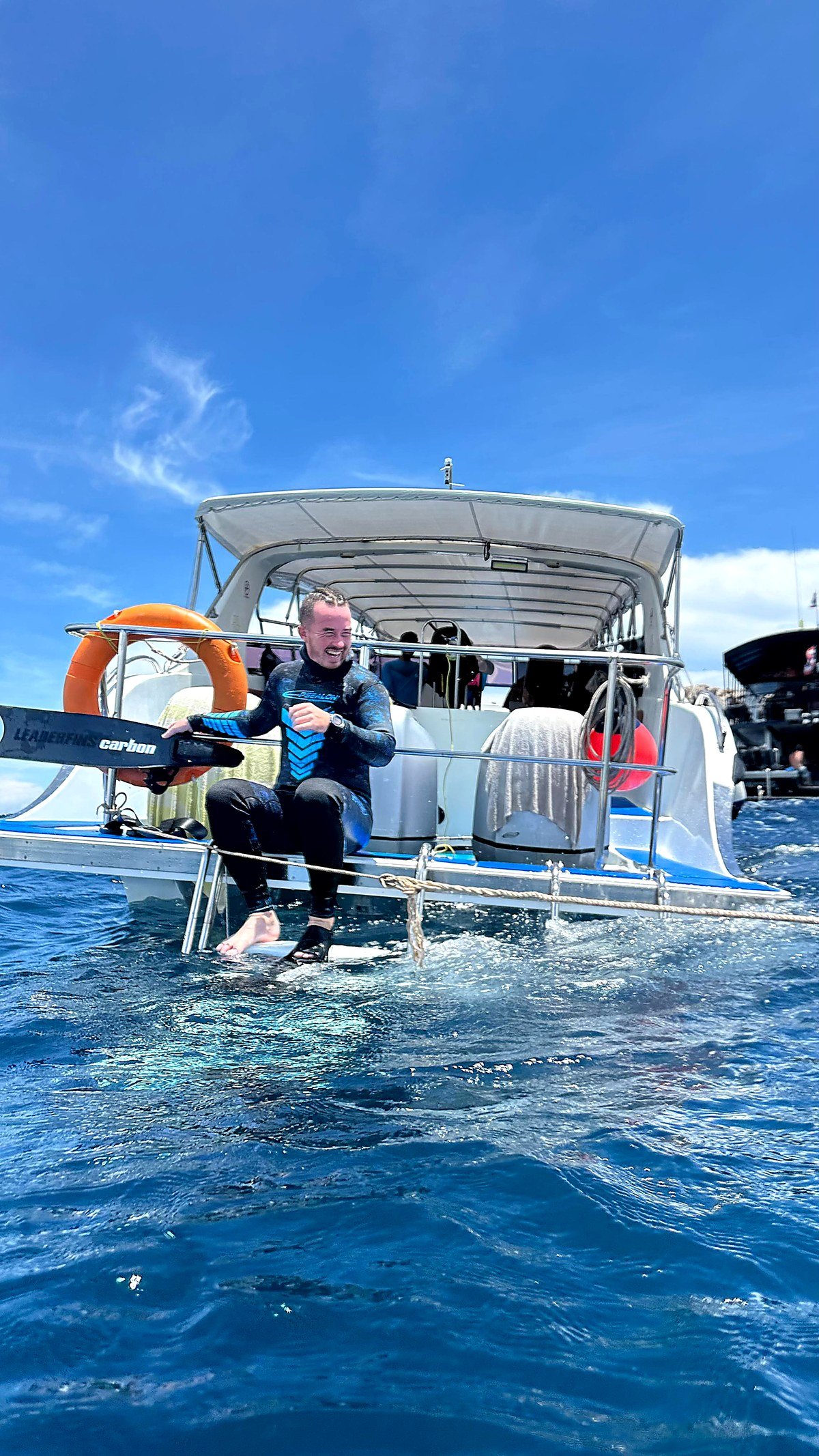
About Diego Pauel
Diego has been teaching freediving from Koh Samui since 2021. He holds instructor certification from Apnea Total and additional credentials across six certification bodies: Oxygen Advantage, Breatheology, International Breathwork Foundation (IBF), Breathing Cold, and GPBA. Plus emergency oxygen administration and first aid.
Learn More →Ready to try freediving?
Message Diego on WhatsApp to check availability for your dates. No deposit needed.
Check Availability on WhatsAppContinue reading
5 Fears Every Beginner Freediver Has (and Why They Are Wrong)
Afraid you cannot hold your breath, equalize, or stay calm underwater? Every beginner freediver has the same 5 fears. He
Read More →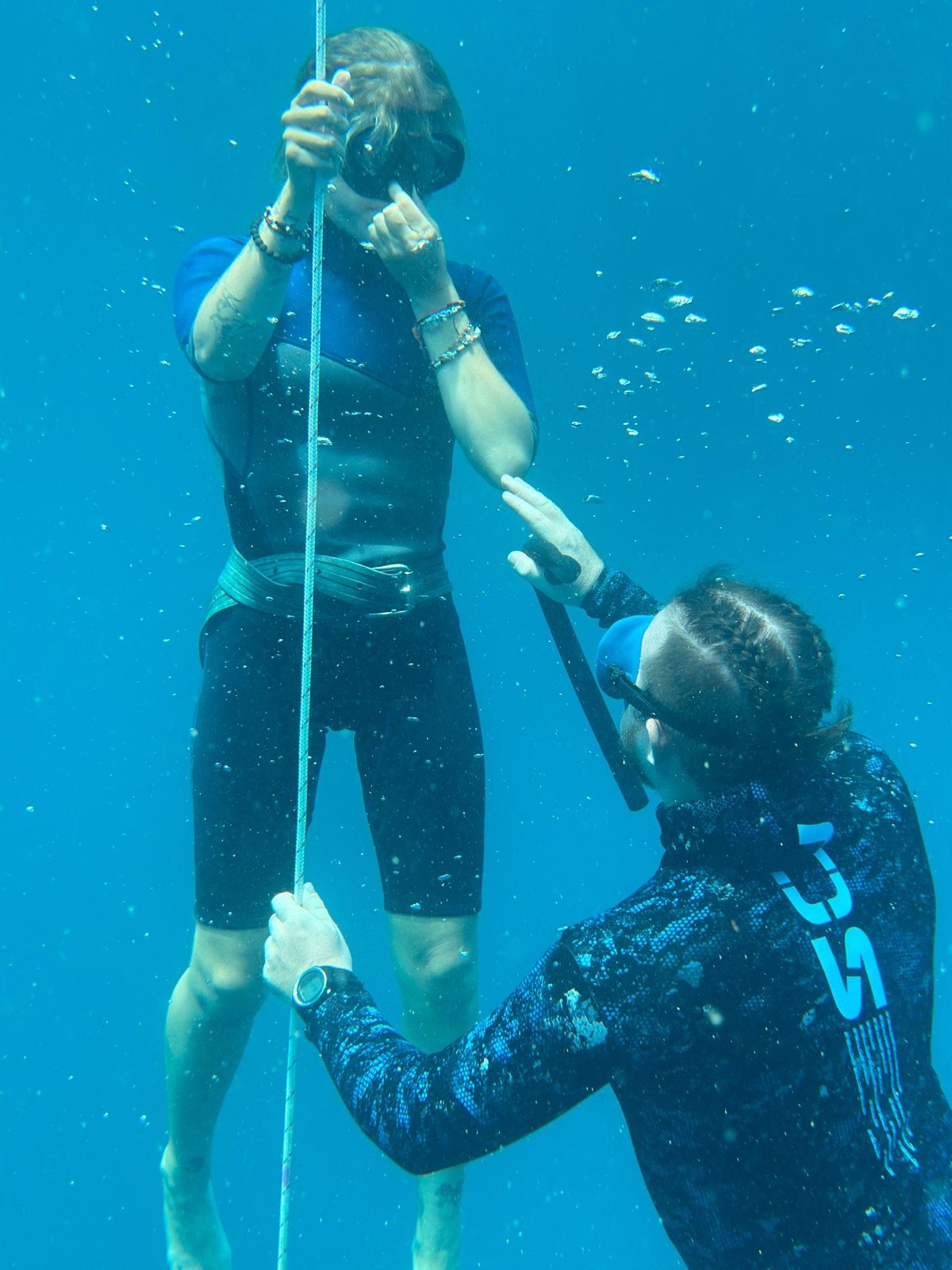
Freediving at Sail Rock from Koh Samui
Everything you need to know about freediving at Sail Rock from Koh Samui. How to get there, what you will see, best cond
Read More →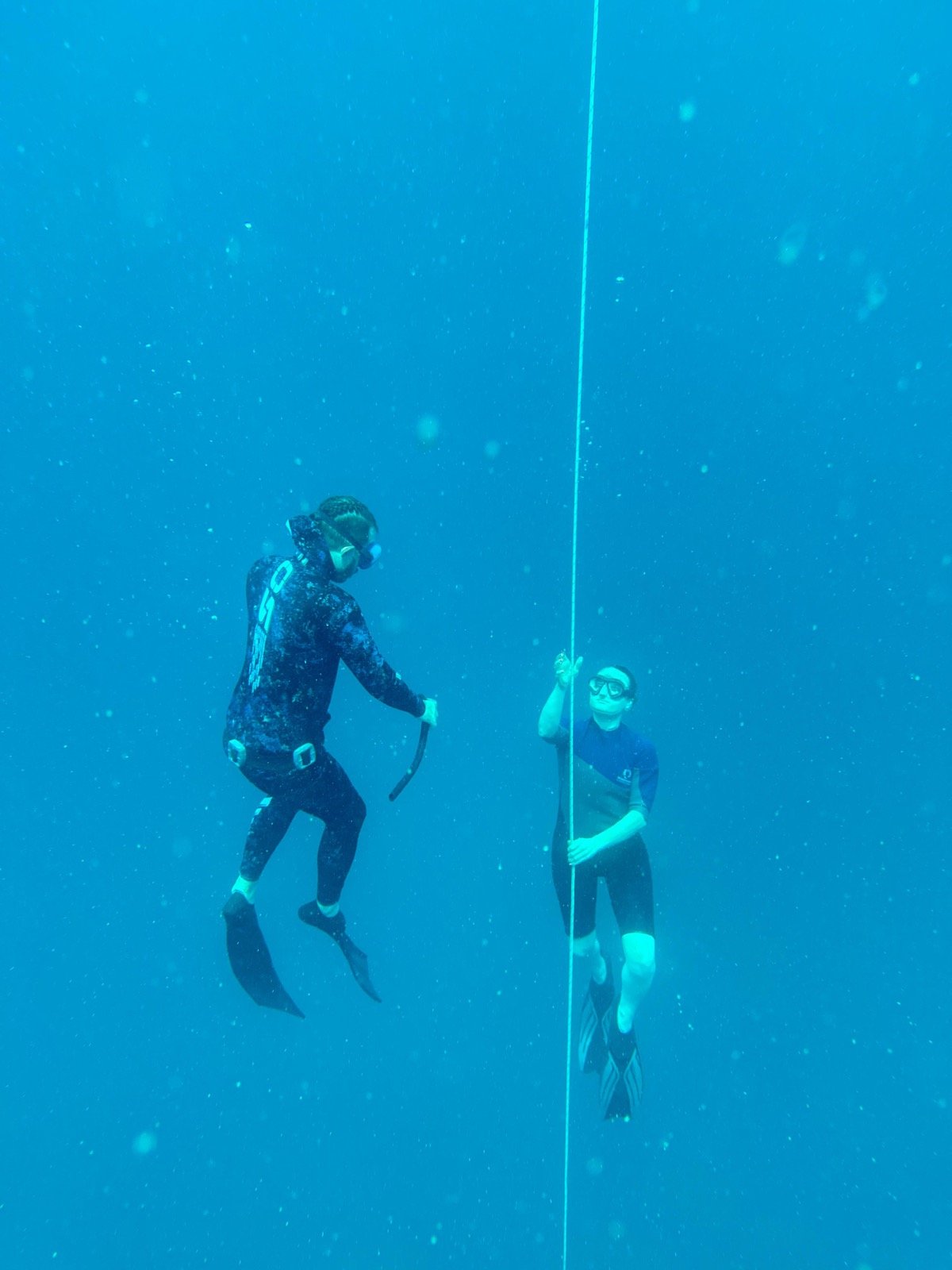
How Deep Can a Beginner Freedive?
How deep can you dive after a beginner freediving course? Most students reach 15 to 20 meters in 3 days. Here is what de
Read More →