How Deep Can a Beginner Freedive?
It is the first question every beginner asks. Before course dates, before pricing, before anything else: how deep will I go?
The honest answer is 15 to 20 meters after a 3 day freediving course. Some students reach deeper. A few stay shallower. But 15 to 20 meters is the range where the majority of beginners finish their Level 1 certification.
That number probably does not mean much to you yet. So let me put it in perspective: 15 meters is roughly the height of a 5 story building. At that depth you are below the reach of surface light scatter, surrounded by open blue water, hovering above coral formations that most snorkelers never see. At 20 meters you are swimming alongside schools of barracuda at Sail Rock, one of the Gulf of Thailand's most spectacular dive sites.
All of that on a single breath.
What Determines How Deep You Go
Depth in freediving is not determined by the things you would expect. It is not about lung size. It is not about fitness. It is not about how long you can hold your breath sitting on your couch. The three factors that actually determine a beginner's depth are equalization, relaxation, and technique.
Equalization
This is the most common limiting factor for beginners. As you descend, water pressure increases and compresses the air spaces in your middle ear. You need to actively push air into your ears to equalize the pressure. If you cannot equalize, you cannot go deeper without pain.
Most students learn the Frenzel technique during the course. Some pick it up in minutes. Others need a full day of practice. Both outcomes are normal. The 3 day course format exists specifically to give students enough time with equalization so that nobody feels rushed.
If equalization clicks on Day 1, you will likely reach deeper targets on Days 2 and 3. If it takes until Day 2, you still have a full day of open water diving ahead. Either way, equalization is a skill you develop, not a talent you are born with. Read the complete equalization guide to start practicing before you arrive.
Relaxation
This sounds vague until you experience it. Relaxation in freediving is measurable. A tense diver burns oxygen faster, moves less efficiently, and reaches their urge to breathe sooner. A relaxed diver glides, conserves, and stays comfortable at depth.
On your first few dives, you will be tense. Your grip on the line will be too tight, your kick will be too fast, and your mind will be running through a checklist of everything that could go wrong. This is normal. By your 10th or 15th dive, those patterns start to dissolve. Your body learns that depth is not dangerous when you are prepared. Your movements become slower. Your oxygen lasts longer. Your depth increases without any extra effort.
The students who reach 20 meters on Day 3 are almost never the strongest swimmers in the group. They are the ones who figured out how to let go.
Technique
A good duck dive, streamlined body position, and efficient finning reduce the energy cost of every meter. On Day 1, your duck dive might get you to 2 or 3 meters before you start kicking. By Day 3, a clean duck dive sends you to 5 meters before you take your first stroke. That is 5 meters of depth for zero energy. At 15 to 20 meter targets, technique improvements like this make the difference between a dive that feels like a struggle and a dive that feels like flying.
The Day by Day Progression
Day 1: Theory and Confined Water
You do not dive deep on Day 1. You do not need to. The first day covers breathing techniques, freediving physiology, equalization theory, and static breath holds in shallow, confined water.
By the end of Day 1, most students have held their breath for 2 minutes or longer face down in the water. That alone surprises nearly everyone. If you tried at home and managed 40 seconds, the jump to 2 minutes feels impossible until you experience the difference that proper technique makes.
You also practice duck dives, learn the buddy safety protocol, and do your first Frenzel equalization attempts. There is no depth pressure on Day 1. The goal is building the foundation that makes the next two days possible.
Day 2: Open Water Training
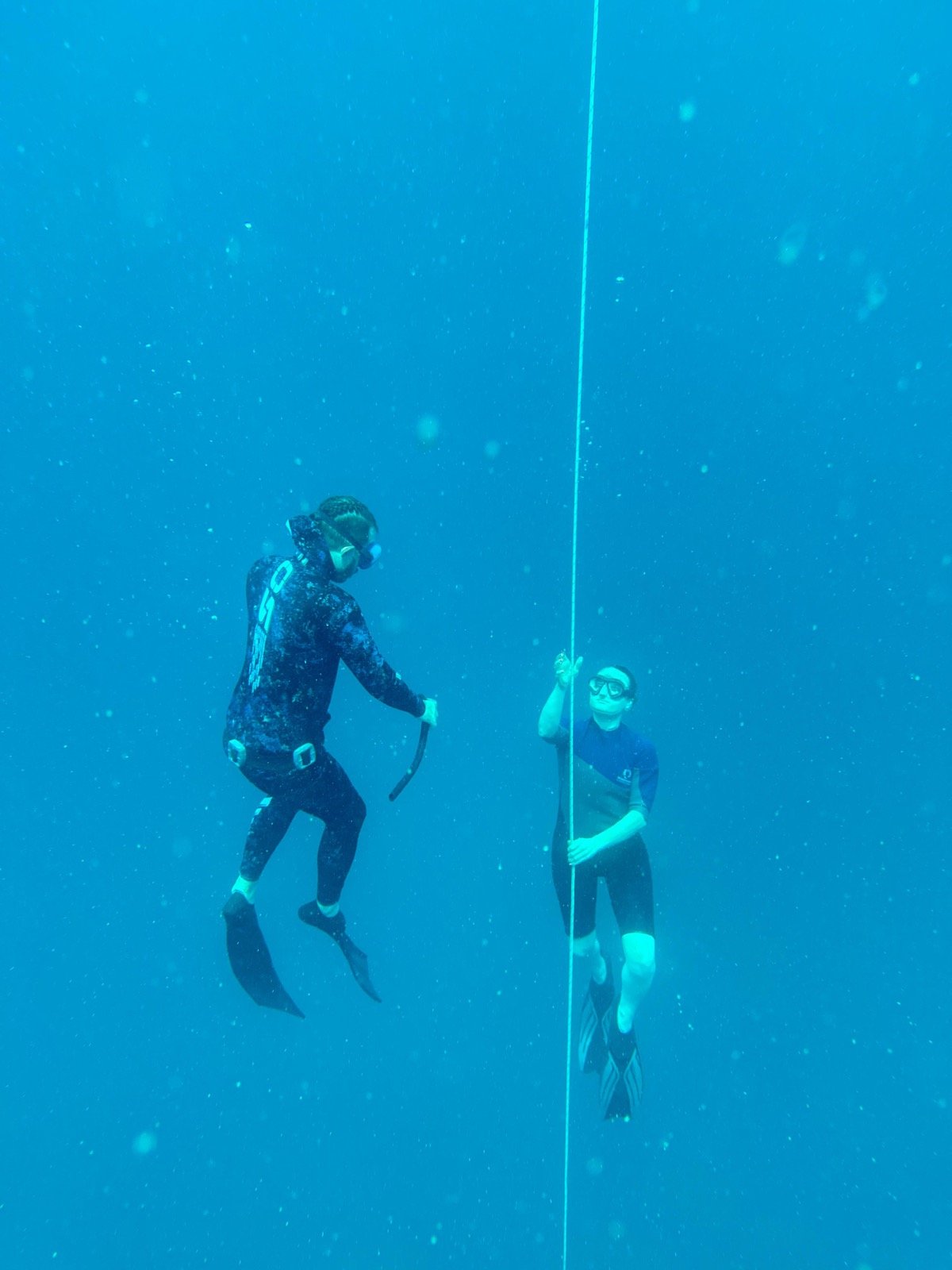
Day 2 is where depth starts. You descend along a dive line in open water, using the rope as a guide and reference point. You know exactly how deep you are at all times. Your instructor watches from the surface and meets you at the top of every dive.
The progression is gradual. First dive: 5 meters. Then 8. Then 10. Each target increases only when you are comfortable at the previous depth. If 10 meters feels good and your equalization is clean, you move to 12. If 10 is your limit today, 10 is your target. There is no fixed schedule and no requirement to match anyone else.
Most students finish Day 2 between 10 and 15 meters. A few reach deeper. A few stay at 10. All of these outcomes represent real progress from someone who had never freedived 36 hours earlier.
Day 3: Sail Rock or Open Water Site
Day 3 takes everything from the first two days and puts it in context. You dive at a real site, often Sail Rock, where the water is deep blue, the marine life is dense, and the experience stops feeling like training and starts feeling like the reason you came.
This is where most students reach their deepest dives. The combination of experience accumulated over two days, familiarity with the sensations of depth, and the motivation of diving at a world class site pulls everything together. A student who reached 12 meters on Day 2 often pushes to 15 or 18 on Day 3. The 15 meter student reaches 20.
The certification target for Apnea Total Level 1 is 10 meters of constant weight freediving. Most students exceed that by Day 2. Day 3 is about exploration, confidence, and experiencing why people become addicted to this sport.
Why Depth Is Not the Point
After reading all of that, here is the truth that every experienced freediver eventually discovers: depth is not the point.
The number on the line is a useful benchmark. It tells you something about your technique, your relaxation, and your equalization. But the experience of freediving is not about how many meters you reach. It is about the 60 seconds between the surface and your turn. The silence. The color of the water shifting from turquoise to blue. The moment your body reaches neutral buoyancy and you stop kicking because the ocean is pulling you down on its own. The turtle that passes beneath you at 12 meters while you hang motionless on the line.
A 15 meter dive at Sail Rock with clear visibility and barracuda circling below is a better experience than a 25 meter dive in murky water on a blank line. Depth is a number. The dive is an experience. One of the best things about a 3 day course is that you get enough dives to stop obsessing about the number and start paying attention to what is actually happening around you.
How Deep After Certification
Your Level 1 certification is a starting point, not a ceiling. After the course, you have the skills to continue training independently or with a buddy. Most certified freedivers find that regular practice over the following weeks and months brings steady depth gains without any additional instruction.
If you want to go deeper with guided supervision, there are two paths.
Fun dives and coaching sessions let you continue training at Sail Rock or other Gulf of Thailand sites with your instructor. These are single day sessions focused on depth progression, technique refinement, and exploring new dive sites. Some students book a fun dive day immediately after their course to capitalize on the momentum.
The Advanced Course (Level 2) takes you deeper in a structured format. You learn mouthfill equalization, the technique that replaces Frenzel below 20 to 25 meters where lung compression makes Frenzel difficult. Advanced students typically reach 25 to 30+ meters depending on their starting point. The course runs 3 days and requires a Level 1 certification from any agency.
The Physics of Going Deep
Understanding what happens to your body at depth helps remove the mystery.
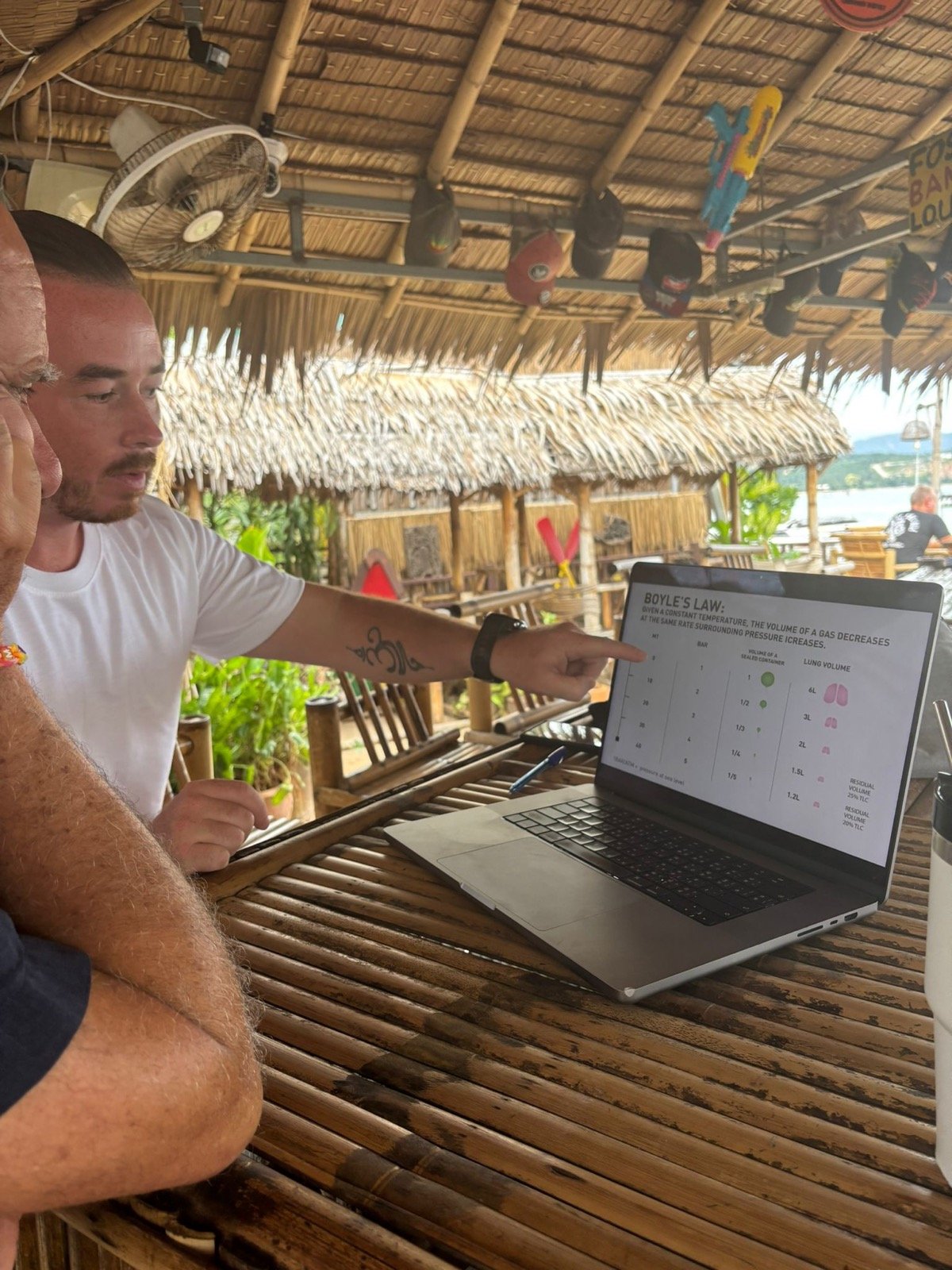
At the surface, the air in your lungs is at 1 atmosphere of pressure. At 10 meters, the pressure doubles to 2 atmospheres. Your lungs compress to half their surface volume. At 20 meters, the pressure is 3 atmospheres and your lungs are at one third their original size. This compression is not painful. Your body adapts to it naturally through the mammalian dive reflex, which shifts blood into your chest cavity to prevent the lungs from collapsing further.
What you feel during a descent is primarily the need to equalize your ears. Every 1 to 2 meters, you perform a small Frenzel equalization. Between equalizations, you are gliding. The sensation is closer to flying than swimming. Your body is in freefall, sinking without effort once you pass the depth where you become negatively buoyant. For most people in a thin wetsuit, that crossover point is around 10 to 12 meters. Below that, gravity does the work.
This freefall phase is what most freedivers describe as the best part of the dive. You stop kicking, tuck your arms, and let yourself sink in silence. The deeper you go, the longer the freefall lasts. At 20 meters, you might fall for 3 to 4 seconds without moving at all. It is unlike anything else you have experienced in or out of the water.
How Long Does a 20 Meter Dive Take
One of the biggest misconceptions about freediving is that deep dives require long breath holds. A dive to 20 meters from the surface and back takes roughly 45 to 55 seconds for a trained beginner. The descent takes about 20 to 25 seconds, the turn takes 3 to 5 seconds, and the ascent takes another 20 to 25 seconds.
Under a minute. That is it. You are not holding your breath for 3 minutes at the bottom of the ocean. You are making a controlled round trip that lasts less than a minute, and for most of the descent you are barely moving because freefall is doing the work.
When students hear this for the first time, the math changes everything. "I can hold my breath for 2 minutes, and the dive only takes 50 seconds?" Suddenly the gap between what your body can do and what the dive requires becomes obvious. The margin of safety is enormous. You are using less than half your breath hold capacity for a dive that most beginners would consider deep.
What If I Do Not Reach 20 Meters
You might not. And that is completely fine.
Some students finish their Level 1 at 12 meters. Others at 15. The certification requires 10 meters of constant weight freediving. Everything above that is a bonus, not a requirement.
The factors that slow depth progression are almost always equalization (the most common), anxiety (which improves with exposure), or simply needing more time than 3 days provide. None of these are failures. They are starting points. A student who finishes at 12 meters comfortable and confident has a better foundation than one who was pushed to 20 before they were ready.
Freediving is not a race. Your depth will increase naturally as you practice. Some of the fastest progressions happen in the weeks after a course, when the technique has settled in and the experience has reduced the anxiety. Students who return for coaching sessions a week or a month later often surprise themselves by how much easier depth feels the second time around.
Ready to Find Out
You have read the numbers. You know the progression. You understand what determines how deep you go. The only thing left is to get in the water and find out where your body takes you.
The beginner course on Koh Samui runs 3 full days with a maximum of 3 students per instructor. You train at Sail Rock, you dive at your own pace, and you carry emergency oxygen on every boat. No rushing, no crowds, no pressure to hit a number that does not matter.
Read the complete guide to freediving in Koh Samui for logistics, pricing, and dive site details. Or message us on WhatsApp to check available dates. The depth is there. The question is whether you are ready to see it for yourself.
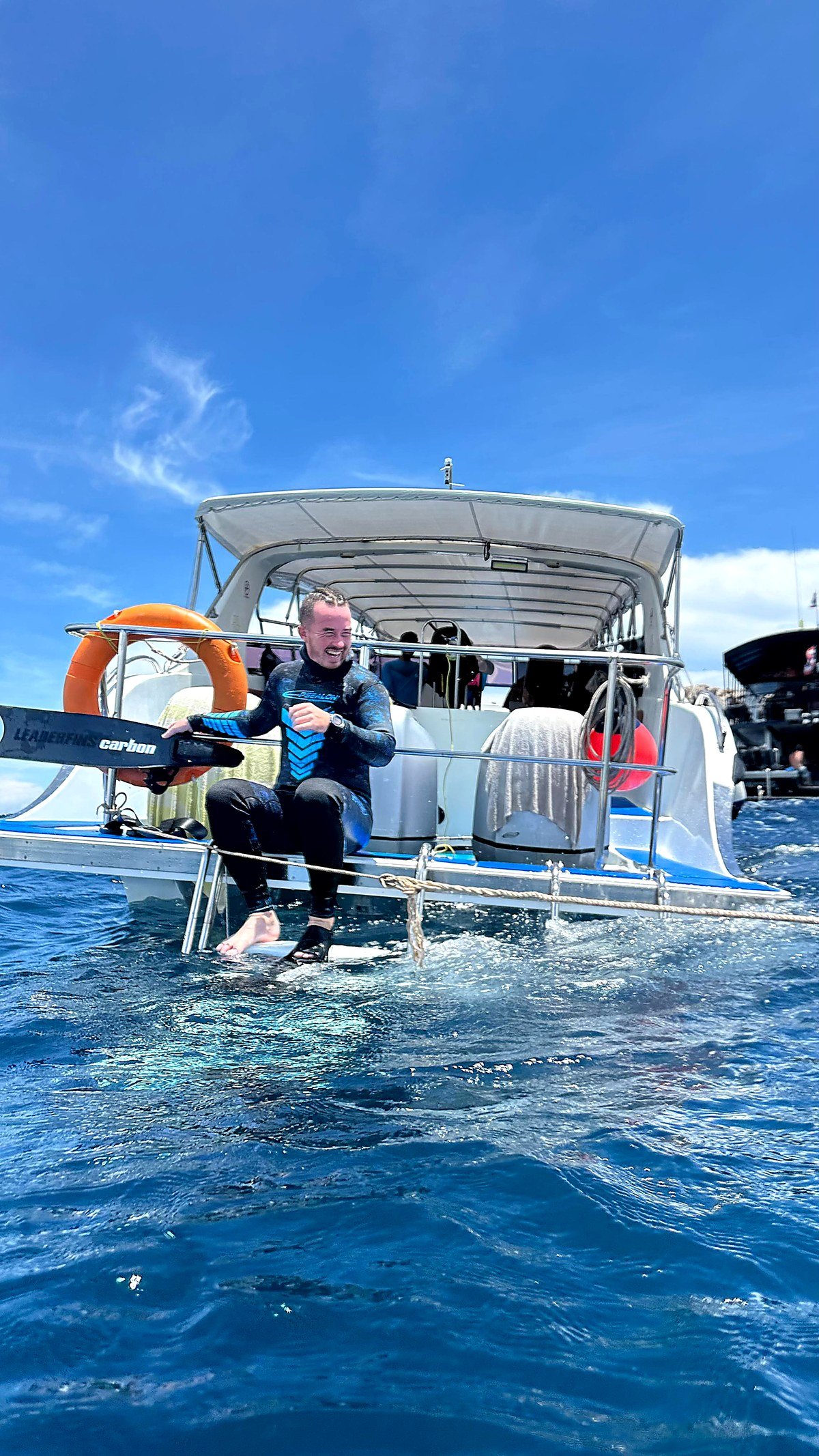
About Diego Pauel
Diego has been teaching freediving from Koh Samui since 2021. He holds instructor certification from Apnea Total and additional credentials across six certification bodies: Oxygen Advantage, Breatheology, International Breathwork Foundation (IBF), Breathing Cold, and GPBA. Plus emergency oxygen administration and first aid.
Learn More →Ready to try freediving?
Message Diego on WhatsApp to check availability for your dates. No deposit needed.
Check Availability on WhatsAppContinue reading
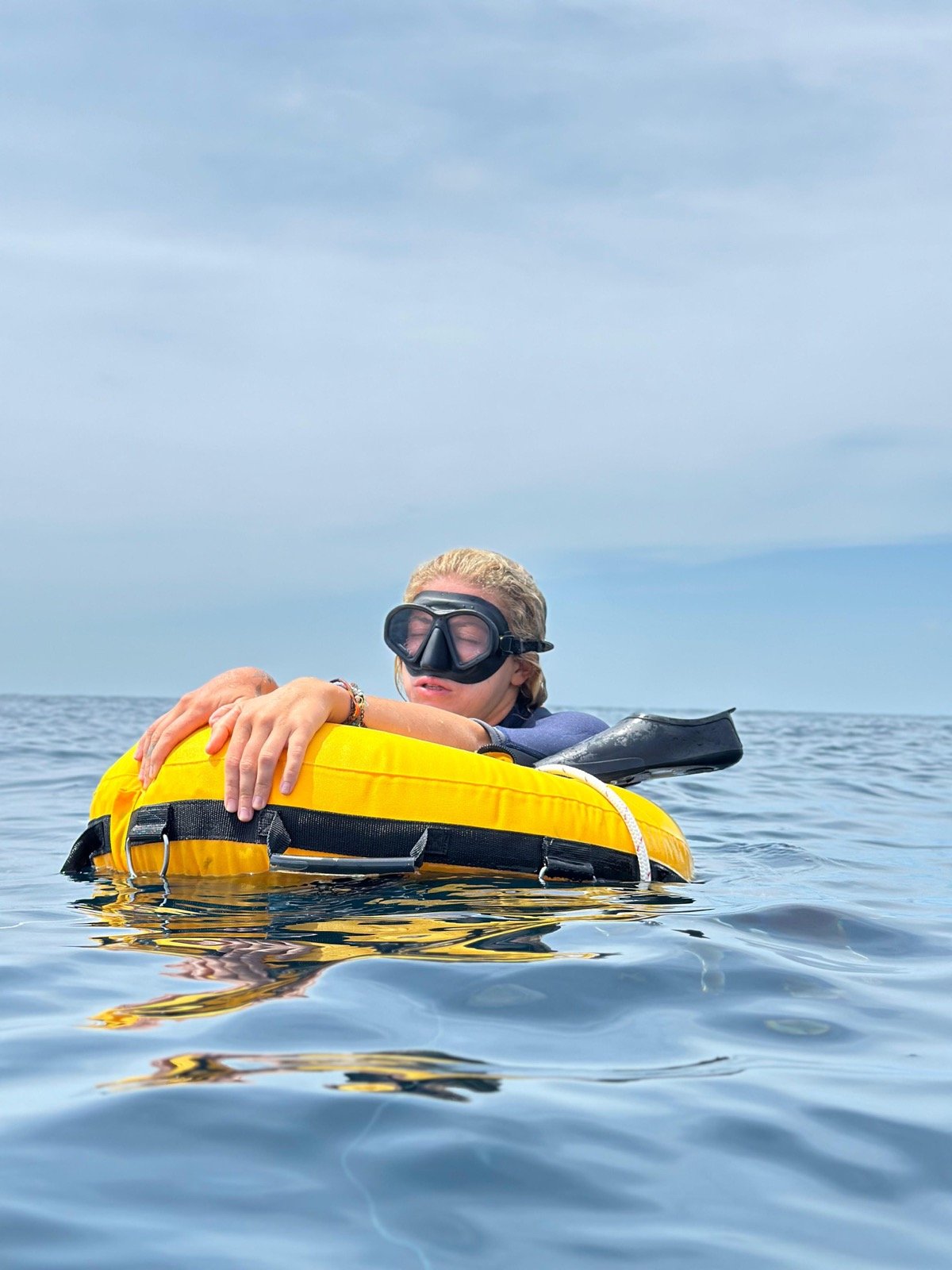
Why You Can't Equalize Freediving — and How to Fix It
Can't equalize when freediving? An honest fix-it guide from a Koh Samui instructor. The most common reasons your ears wo
Read More →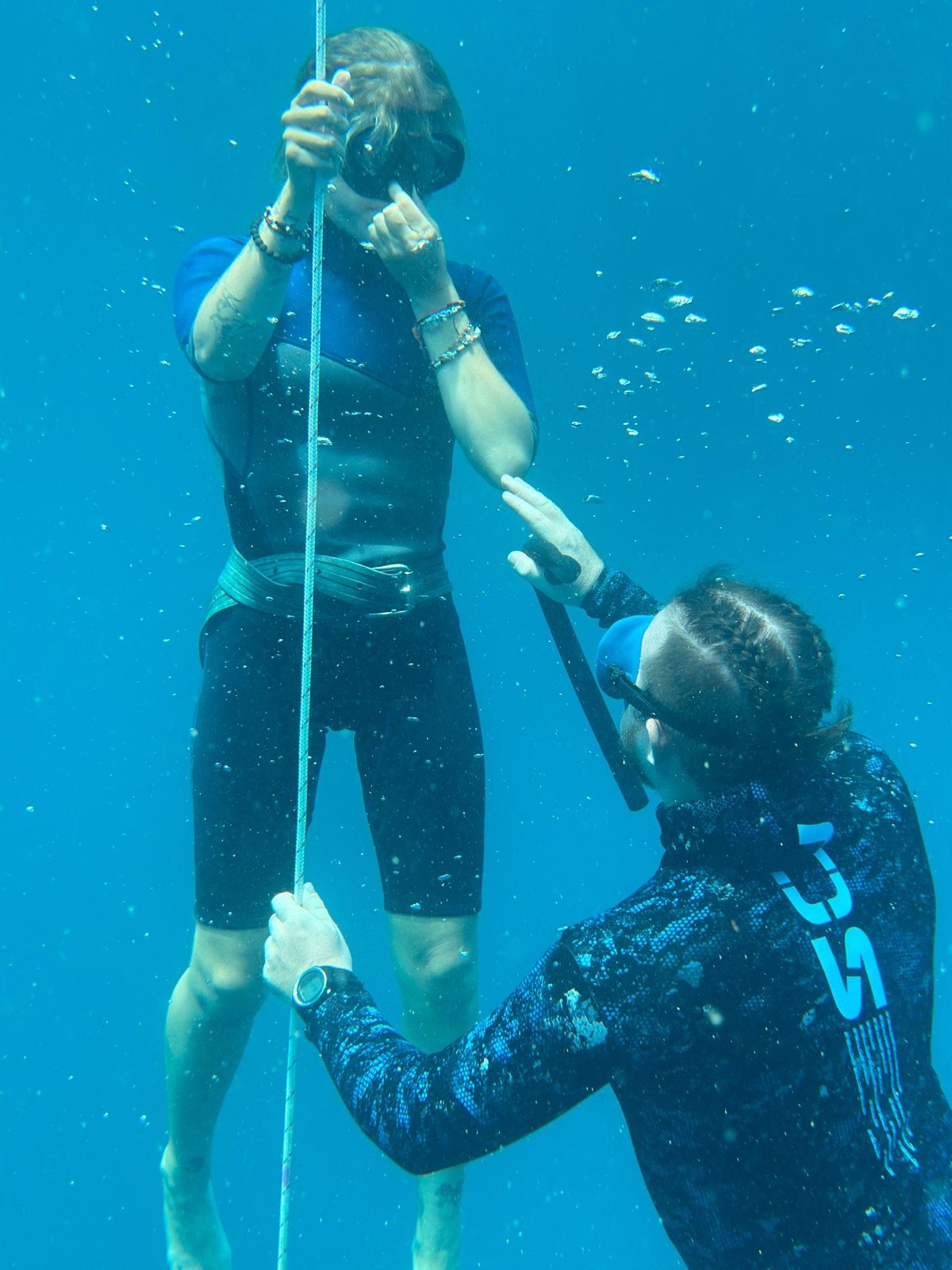
How to Hold Your Breath Longer for Freediving
How do you hold your breath longer for freediving? The honest answer from a Koh Samui instructor: it is mostly relaxatio
Read More →