Freediving Certifications Compared: AIDA vs PADI vs Apnea Total
You have decided to take a freediving course. You start researching and immediately hit a wall of acronyms: AIDA, PADI Freediver, Apnea Total, SSI, Molchanovs. Each one claims to be the best. Each one has a slightly different course structure, different level names, and different depth requirements. It is confusing.
This guide breaks down the three most common certification agencies you will encounter when booking a freediving course: AIDA, PADI Freediver, and Apnea Total. By the end, you will understand what each one offers, how they compare, and which one actually matters for your freediving future.
The Three Major Certification Bodies
Before diving into the comparison, here is what each agency is and where it comes from.
AIDA: The Original
AIDA stands for Association Internationale pour le Developpement de l'Apnee. Founded in 1992 in France, it is the oldest dedicated freediving agency in the world. AIDA governs competitive freediving, sets world records, and has trained more freedivers than any other organization.
If you have ever seen a freediving competition on YouTube or Netflix, it was almost certainly run under AIDA rules. The agency is synonymous with the sport itself.
AIDA's strength is recognition. Walk into any dive center or freediving school on the planet and show an AIDA card. They know exactly what it means. AIDA is the gold standard in name recognition, particularly in Europe, the Middle East, and the Americas.
AIDA's certification levels progress as follows:
- AIDA 1 (Introduction): A short introductory course, often half a day or a single day. Covers basic theory, pool breath holds, and a shallow open water dive. No minimum depth requirement. This is a taster, not a full certification.
- AIDA 2 (Freediver): The standard beginner course. 2 to 3 days of training covering theory, pool sessions (static apnea and dynamic apnea), and open water dives. You must reach 16 meters constant weight, hold a 2 minute static, and swim 40 meters dynamic to pass.
- AIDA 3 (Advanced Freediver): For certified freedivers who want to push deeper. Covers advanced equalization, rescue protocols, and deeper constant weight dives. Minimum 24 meters constant weight, 2 minute 45 second static, 55 meters dynamic.
- AIDA 4 (Master Freediver): The highest recreational level. Requires 32 meters constant weight, 3 minute 30 second static, and 70 meters dynamic. Covers advanced rescue, mouthfill equalization, and deep diving theory.
- AIDA Instructor: A separate certification track for those who want to teach. Requires passing all AIDA 4 standards plus teaching assessments.
PADI Freediver: The Dive Shop Giant
PADI is the biggest name in scuba diving with over 6,600 dive centers and resorts worldwide. In 2014, PADI launched its freediving program, bringing the same infrastructure and marketing muscle to breath hold diving.
PADI's advantage is accessibility. If there is a dive shop near you, there is a good chance it offers PADI Freediver courses. You do not need to find a dedicated freediving school. Your local scuba center might run freediving courses on weekends.
This is also PADI's potential weakness. Many PADI Freediver instructors are primarily scuba instructors who added freediving to their offerings. Some are excellent freedivers. Others completed the minimum requirements and started teaching. The quality varies more than with agencies where freediving is the sole focus.
PADI Freediver certification levels:
- PADI Basic Freediver: A pool only introduction. Covers theory, confined water skills, and static and dynamic apnea. No open water component. Think of it as a taster session.
- PADI Freediver: The standard beginner course. Theory, confined water, and open water sessions. Requires a 90 second static, 25 meter dynamic, and a 10 meter constant weight dive.
- PADI Advanced Freediver: Deeper training with a minimum 20 meter constant weight dive, 2 minute 30 second static, and 50 meter dynamic. Covers advanced equalization and rescue skills.
- PADI Master Freediver: The highest level. Requires 28 meter constant weight, 3 minute 30 second static, and 70 meter dynamic. Includes advanced rescue scenarios and deep diving techniques.
- PADI Freediver Instructor: Requires active PADI Freediver Instructor Trainer supervision and completion of the instructor development course.
Apnea Total: The Flexible Alternative
Apnea Total was founded in 2004 by Lotta Ericson in Sweden. It has grown steadily, with a strong presence in Southeast Asia, Central America, and Europe. If you take a freediving course in Thailand, the Philippines, or Mexico, there is a good chance it is Apnea Total.
Apnea Total's defining feature is its approach to assessment. Unlike AIDA and PADI, which require specific depth and time performances to pass, Apnea Total certifies based on demonstrated competence. Your instructor evaluates your technique, safety knowledge, equalization ability, and comfort level rather than whether you hit a number on a depth gauge.
This is not a lower standard. It is a different philosophy. Some students equalize easily and reach 20 meters on Day 2. Others have excellent technique but need more time to develop their equalization. Under Apnea Total, both students can be certified because both have demonstrated the skills needed to freedive safely.
Apnea Total certification levels:
- Level 1 (Beginner): The standard beginner course. 2 to 3 days covering freediving physiology, breathing techniques, Frenzel equalization, duck dive, safety protocols, and open water dives. No minimum depth requirement for certification. Instructor assesses overall competence. Comparable to AIDA 2.
- Level 2 (Advanced): Covers mouthfill equalization introduction, advanced constant weight technique, deeper rescue protocols, and exhale diving. Comparable to AIDA 3. Assessment is competency based.
- Level 3 (Master): Advanced training including mouthfill mastery, FRC diving, competition preparation, and instructor level safety skills. Comparable to AIDA 4.
- Instructor Levels: A structured instructor training path that requires both personal diving ability and teaching competency.
Side by Side Comparison
Here is how the three agencies stack up across the criteria that matter most when choosing a course.
| Criteria | AIDA | PADI Freediver | Apnea Total |
|---|---|---|---|
| Founded | 1992 | 2014 | 2004 |
| Global Recognition | Highest | High (via PADI scuba network) | Growing, strong in Asia |
| Assessment Method | Performance based (depth/time minimums) | Performance based (depth/time minimums) | Competency based (instructor assessed) |
| Beginner Course Duration | 2 to 3 days | 2 to 3 days | 2 to 3 days |
| Beginner Depth Requirement | 16m (AIDA 2) | 10m (PADI Freediver) | No minimum (assessed) |
| Advanced Depth Requirement | 24m (AIDA 3) | 20m (Advanced) | No minimum (assessed) |
| Beginner Static Requirement | 2 minutes | 90 seconds | No minimum (assessed) |
| Typical Price Range (Beginner) | $250 to $500 USD | $300 to $550 USD | $200 to $400 USD |
| Competition Governance | Yes (governs competitions) | No | No |
| Instructor Flexibility | Moderate (standardized) | Low (highly standardized) | High (adapts to students) |
| Strongest Region | Europe, Middle East, Americas | Worldwide (via scuba network) | Southeast Asia, Central America |
What the Depth Requirements Actually Mean for You
The depth requirements deserve extra attention because they affect your experience as a student more than you might expect.
With AIDA, you must reach 16 meters to earn your AIDA 2 card. For most healthy adults in warm water with 3 days of training, this is achievable. But some people struggle with equalization. If you cannot equalize past 12 meters by the end of your course, you will not receive certification despite potentially having excellent technique everywhere else.
PADI sets the bar lower at 10 meters for the basic Freediver level. Most students reach this without difficulty, making the PADI Freediver course slightly more accessible for complete beginners.
Apnea Total removes the number entirely. If you demonstrate solid equalization technique, proper safety protocols, good body position, and the ability to dive and ascend safely, you are certified. Your instructor might assess you at 12 meters or 20 meters depending on what you are comfortable with.
Which approach is better? It depends on your perspective. Depth requirements create a clear, measurable standard. Everyone with an AIDA 2 card reached 16 meters, which gives the certification a concrete meaning. Competency based assessment recognizes that freediving skill involves far more than a single number, but it places more trust in the individual instructor's judgment.
For most beginners, this distinction is academic. The vast majority of students hit the required depths regardless of the agency. It only becomes an issue if equalization gives you trouble, which happens to roughly 15 to 20 percent of students on their first course.
Which Certification Is Accepted Where
All three certifications are accepted at dive centers and freediving schools worldwide. No legitimate operation will refuse an Apnea Total card in favor of an AIDA card, or vice versa. They are all recognized as proof that you completed a structured freediving course under professional supervision.
There are two exceptions worth noting:
Competition: If you want to compete in freediving, AIDA governs international competition through CMAS. You do not need an AIDA certification to compete, but you will need to register with AIDA or your national federation. Your Apnea Total or PADI card will not prevent you from entering competitions, but AIDA is the governing body.
Crossovers: If you start with one agency and later want to train with another, crossovers are straightforward. An Apnea Total Level 1 is accepted as a prerequisite for an AIDA 3 course. A PADI Freediver card qualifies you for an Apnea Total Level 2. Schools are pragmatic about this because the skills transfer directly.
For travel insurance purposes, all three certifications are treated equally. Policies that cover freediving do not discriminate by agency. What matters is that you hold a valid certification and dive within the limits of your training.
The Truth: Your Instructor Matters More Than Your Card
Here is the part that most certification comparison articles skip.
The agency name on your card matters far less than the person who taught you. A brilliant instructor teaching under Apnea Total will give you a better education than a mediocre instructor teaching under AIDA. A dedicated freediver teaching PADI courses will outperform a scuba instructor who treats freediving as an add on, regardless of what card they hand you at the end.
When choosing a freediving course, ask these questions. They matter more than which logo appears on your certification:
- What is the maximum group size? An instructor watching 3 students gives fundamentally different attention than one watching 8. Smaller groups mean more coaching, faster progression, and better safety coverage.
- Is the instructor primarily a freediver? Some instructors teach freediving as their full time profession. Others are scuba instructors who added freediving to fill schedule gaps. The difference shows in the quality of technique coaching and equalization troubleshooting.
- How many days is the course? A 2 day course with 8 students is a very different product than a 3 day course with 3 students, even if both end with the same certification level.
- Is there emergency oxygen on the boat? This should be non negotiable. If a school does not carry emergency oxygen to open water training, look elsewhere.
- What dive sites do they use? Training at a world class dive site like Sail Rock makes the experience unforgettable. Training in a murky harbor does not.
The certification is proof that you completed the course. The skills you actually take away depend on who taught you and how much personal attention you received.
AIDA vs PADI vs Apnea Total: Quick Recommendations
Choose AIDA if: you want the most widely recognized card globally, you plan to compete in freediving eventually, or you are training in Europe or the Middle East where AIDA dominates. AIDA's standardized curriculum and depth requirements give you a clear benchmark of what you achieved.
Choose PADI Freediver if: there is a PADI center near your home and you want convenient access to courses, you are already a PADI scuba diver and want to keep your certifications under one umbrella, or you prefer the lower entry barrier of a 10 meter depth requirement for the beginner level.
Choose Apnea Total if: you value a flexible, student centered approach to learning, you want your instructor to focus on your technique rather than a depth target, or you are training in Southeast Asia where Apnea Total schools are particularly well established. The competency based assessment means you are certified when you are ready, not when you hit a number.
Or forget the agency entirely and choose the best instructor. Read reviews. Ask about group sizes. Look at the instructor's personal freediving background. A great instructor under any agency will change how you relate to the ocean. A poor instructor under the most prestigious agency will leave you with a card and not much else.
What We Offer on Koh Samui
At Freediving Koh Samui, we teach under Apnea Total. Here is why.
The competency based assessment lets us focus on making you a good freediver instead of stressing about whether you hit 16 meters by the last dive. Some students reach 20+ meters by Day 3. Others reach 14 meters with perfect technique and need a bit more time for equalization to click. Both leave as competent, certified freedivers who know how to dive safely.
Apnea Total also gives us the flexibility to adapt the course to each student. If someone needs extra equalization coaching, we spend extra time on equalization. If conditions change and a different dive site would give you a better experience, we adjust the schedule. Rigid checklists do not produce good freedivers. Responsive, personalized instruction does.
Our Beginner Course runs 3 full days with a maximum of 3 students. You train at Sail Rock and in the sheltered bays around Koh Samui. Emergency oxygen is on every boat. Your certification is Apnea Total Level 1, recognized worldwide and equivalent to AIDA 2 or SSI Level 1.
The Advanced Course runs 3 days with the same small group format. You work on mouthfill equalization, advanced constant weight technique, and deeper safety protocols. Certification is Apnea Total Level 2.
Your instructor holds credentials from Apnea Total, the Oxygen Advantage, Breatheology, the International Breathwork Foundation, Breathing Cold, and GPBA. Six certification bodies, one instructor, and a maximum of 3 students to focus on.
Ready to Start
The certification agency debate is worth understanding, but do not let it delay your first course. Whether you train under AIDA, PADI, or Apnea Total, the act of freediving, taking a single breath and descending into the blue, is the same transformative experience.
Pick the school with the best instructor, the smallest group, and the most compelling dive sites. The card you receive at the end is a bonus. The skills and the experience are what stay with you.
If Koh Samui is on your itinerary, check out our available courses or message Diego directly on WhatsApp to ask about dates and availability. No deposit required. Just a quick conversation about what you are looking for.
About Diego Pauel
Diego has been teaching freediving from Koh Samui since 2021. He holds instructor certification from Apnea Total and additional credentials across six certification bodies: Oxygen Advantage, Breatheology, International Breathwork Foundation (IBF), Breathing Cold, and GPBA. Plus emergency oxygen administration and first aid.
Learn More →Ready to try freediving?
Message Diego on WhatsApp to check availability for your dates. No deposit needed.
Check Availability on WhatsAppContinue reading
Freediving vs Snorkeling: What's the Difference and Which Should You Try?
Snorkeling and freediving both put you in the ocean, but the experience is completely different. Here is a clear breakdo
Read More →
Best Freediving School in the Gulf of Thailand
How to choose the best freediving school in the Gulf of Thailand. Compare Koh Samui, Koh Tao, and Koh Phangan schools by
Read More →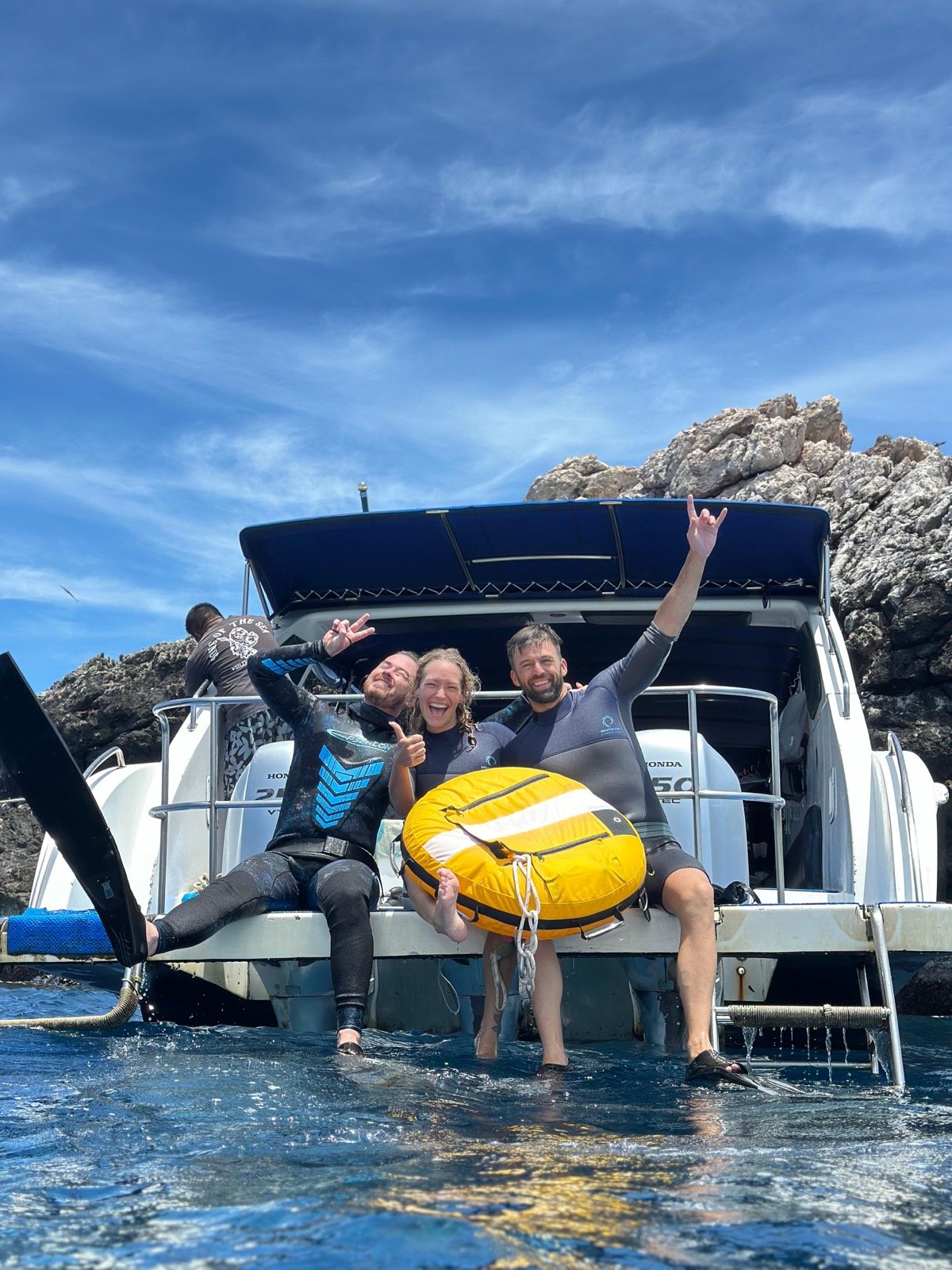
Freediving vs Scuba Diving: Which One Is Right for You
An honest comparison of freediving and scuba diving. Equipment, cost, training, experience, and which one suits you bett
Read More →