Can You Freedive with a Cold?
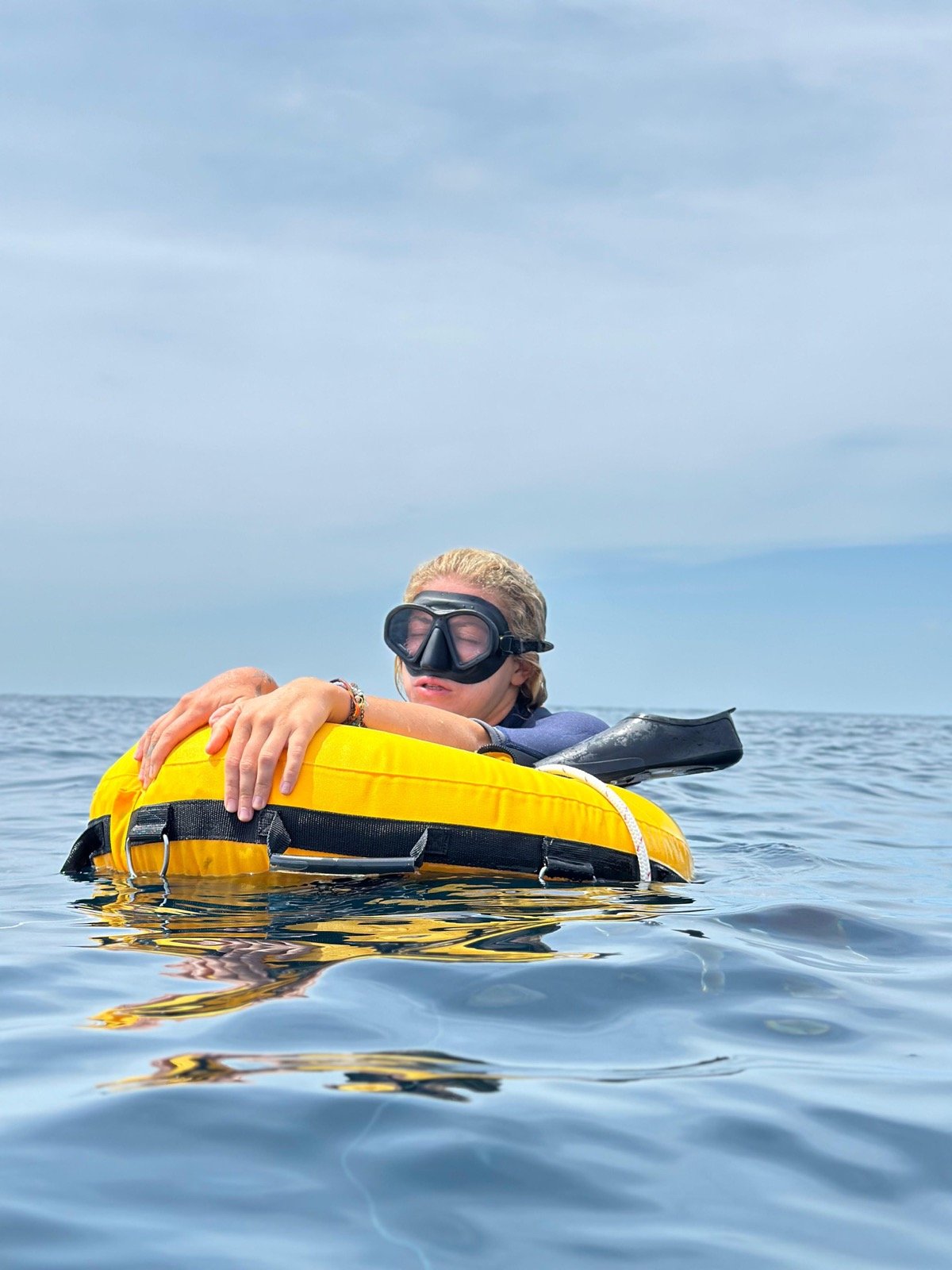
You booked your freediving course. You flew to Koh Samui. And now you have a cold.
Or maybe you are planning a trip and wondering whether that occasional stuffy nose you get every few weeks will be a problem. Or your partner has been sniffling for days and you are sharing a room.
The direct answer is this: do not freedive with a cold. Not with congestion, not with sinus pressure, not with a blocked ear. The risks are real and some of them are serious enough to end your trip early.
Here is what you need to understand, why it matters, and what to do if you get sick before your course.
Why a Cold Makes Freediving Dangerous
Freediving requires you to equalize pressure in your ears and sinuses on every descent. As you go deeper, the water pressure increases and the air spaces in your head need to adjust or you will feel pain. Significant pain. Below about 10 meters, unequalized pressure causes real ear damage.
Equalization works by connecting your middle ear to your throat through the eustachian tubes. When you perform a Frenzel maneuver or a standard Valsalva, you push air up through those tubes to match the external pressure.
When you have a cold, the eustachian tubes swell. Mucus blocks them. The passages that need to open and close in response to pressure changes are congested. You will try to equalize and nothing will happen. Or worse, you will force equalization and push infected fluid into spaces where it should not be.
Three things can go wrong:
Ear Squeeze
If you cannot equalize your ears, the pressure differential between the outside water and your middle ear causes a squeeze. Mild squeeze is painful. Severe squeeze ruptures the eardrum. A ruptured eardrum means cold water floods the ear canal, causing immediate and extreme disorientation. In a freediver without a safety buddy, that is a blackout scenario.
Sinus Squeeze
Your sinuses are also air spaces that need to equalize. With congestion blocking the passages, descending creates a vacuum in the sinus cavity. The result is significant facial pain and, in severe cases, blood in the mask at the surface. Sinus squeeze is less life threatening than ear squeeze but it is genuinely painful and will end your dive day.
Barotrauma and Infection
Forcing air through blocked passages while descending can push bacteria from your throat into the middle ear. This creates a middle ear infection that takes days or weeks to resolve, during which diving is not possible. Some people come to Koh Samui with a mild cold, try to push through, and spend the rest of their trip recovering from an ear infection they did not need to get.
What Counts as Too Sick to Dive
These symptoms mean you should not get in the water:
- Nasal congestion or a blocked nose
- Sinus pressure or facial pain
- Blocked or muffled ear
- Active ear infection or recent history of ear infection
- Postnasal drip that is causing throat irritation
- Any difficulty breathing through your nose
These symptoms do not prevent you from diving:
- A mild cough that does not involve congestion or sinus pressure
- A sore throat without any ear or sinus involvement
- General tiredness but no ear or respiratory symptoms
The test is simple. Pinch your nose and try to blow gently against the pressure. If your ears equalize cleanly, the passages are open. If nothing happens, if you feel resistance, if one ear works and the other does not, do not dive.
What About Decongestants and Antihistamines
Some divers take decongestants to open up blocked passages before a dive. This works in the short term. The problem is the rebound effect.
A common decongestant like pseudoephedrine or oxymetazoline nasal spray opens the passages for a few hours. If your dive runs longer than the medication window, or if you are making multiple dives over a long day at Sail Rock, the medication wears off while you are underwater and the passages close again. You descended fine. You cannot equalize on the way back down for your next dive, or your passages close mid dive.
Antihistamines carry a different problem. Many of them cause drowsiness and reduce your cognitive alertness. Freediving requires focus and relaxation. A drowsy freediver is not a safe freediver.
The professional advice is straightforward: do not use medication to enable diving when you are sick. If you need medication to open your ears, you should not be diving. The congestion is telling you something that the medication is only masking.
What to Do If You Get Sick Before Your Course
The most common situation is this: you arrive on Koh Samui with a course booked for Monday. You wake up Saturday morning with a blocked nose and sore ears.
Message Diego on WhatsApp immediately. Do not wait until the morning of the course to mention it.
Most mild colds resolve in 3 to 5 days. Koh Samui courses run Monday to Wednesday for Level 1 and Tuesday to Thursday for Level 2. There is usually flexibility to push a course back by a few days if you need it. A short delay is much better than starting a course you cannot complete, or worse, starting and creating an ear injury that ruins the rest of your trip.
Rest. Drink fluids. Sleep. Give your body the recovery time it needs. Koh Samui is a good place to recover from a cold. Warm weather, good food, and no reason to rush.
If your cold has mostly cleared but you are still getting occasional blocked ears, wait one more day and test again in the morning. Morning equalization tests are the most reliable because sinus congestion often worsens overnight.
What If You Are Mostly Recovered
You had a cold but it is mostly gone. The question is whether you are actually ready to dive or whether you are just telling yourself that because you do not want to postpone.
Perform the equalization test again. Pinch your nose and try to equalize both ears. Both need to open cleanly. If there is any hesitation or resistance, wait.
If both ears equalize easily, you have no sinus pressure, no congestion, and you feel physically fine, you are likely ready. It is always worth mentioning your recent illness to your instructor at the start of Day 1. Your instructor will check in on your equalization during the theory session and will be watching your descent technique closely during the first pool session. If something is not right, it gets caught early in shallow water where it is easy to stop and address.
What About Allergies
Seasonal allergies and hay fever are a different situation from a cold. If you have well managed allergies that cause mild nasal congestion but your ears equalize cleanly, you may be able to dive.
The relevant question is always whether your eustachian tubes are functioning. Some people with mild year round congestion from allergies have no difficulty equalizing because the congestion does not extend to the middle ear passages.
If your allergies are causing significant congestion or you are taking antihistamines that affect your alertness, apply the same caution as you would for a cold. Let your instructor know before the course begins.
The Bigger Picture
Freediving asks your body to handle significant physical stress. Your cardiovascular system adjusts to breath holding through the mammalian dive reflex, slowing your heart rate and shifting blood to vital organs. Your lungs compress under pressure. Your middle ears are working against a constant increase in external pressure with every meter of depth.
Any illness that reduces your respiratory or cardiovascular function, impairs your concentration, or compromises your equalization makes that process harder and less safe. The ocean does not care that you flew halfway around the world for this course.
A two day delay to recover from a cold is not a failed trip. A ruptured eardrum at 15 meters because you tried to push through congestion is a failed trip.
Take care of your body first. The course will be there when you are ready.
Frequently Asked Questions
Can I do the theory sessions while I am sick?
Yes. The theory portion of Day 1 does not require you to enter the water. If you are too sick to dive but want to use the recovery day productively, there is flexibility to complete theory and pool sessions in a different order. Discuss this with your instructor in advance.
What if I only have congestion on one side?
One blocked ear is enough to prevent diving. Asymmetric equalization, where one ear equalizes and the other does not, creates a pressure difference between the two middle ears. This causes vertigo during descents, which in open water can disorient you. One blocked side means no diving until both equalize cleanly.
Can I still snorkel if I cannot freedive?
Yes. Surface snorkeling does not require equalization because you are not descending under pressure. If you have a course postponed due to illness, snorkeling at Koh Samui beaches is a reasonable way to enjoy the water while you recover. Just stay at the surface.
How soon after a cold can I freedive?
When your equalization test passes cleanly and you have no sinus pressure or congestion. For most mild colds, this is 3 to 7 days after symptoms peak. Do not use a fixed number of days as your guide. Use the equalization test.
What if I develop congestion during the course?
Tell your instructor immediately. If you develop congestion between Day 1 and Day 2, or between Day 2 and Day 3, the session schedule can be adjusted. Do not try to hide it or push through. Your instructor would rather reschedule a day than supervise a student who cannot equalize at depth.
Message Diego on WhatsApp to check availability or discuss your situation. If you are traveling to Koh Samui specifically for a course, let him know before you arrive if you have any health concerns. It is much easier to plan around them in advance.
About Diego Pauel
Diego has been teaching freediving from Koh Samui since 2021. He holds instructor certification from Apnea Total and additional credentials across six certification bodies: Oxygen Advantage, Breatheology, International Breathwork Foundation (IBF), Breathing Cold, and GPBA. Plus emergency oxygen administration and first aid.
Learn More →Ready to try freediving?
Message Diego on WhatsApp to check availability for your dates. No deposit needed.
Check Availability on WhatsAppContinue reading
Overcoming the Fear of Deep or Dark Water in Freediving
Scared of deep or dark water? A Koh Samui freediving instructor on why that fear is completely normal, how a dive line a
Read More →
Is Freediving Dangerous? An Honest Answer
Is freediving dangerous? The honest answer from a Koh Samui instructor: the real risk is doing it untrained and alone. D
Read More →
5 Fears Every Beginner Freediver Has (and Why They Are Wrong)
Afraid you cannot hold your breath, equalize, or stay calm underwater? Every beginner freediver has the same 5 fears. He
Read More →