The Freediving Duck Dive: How to Get Under the Surface Without Wasting Energy
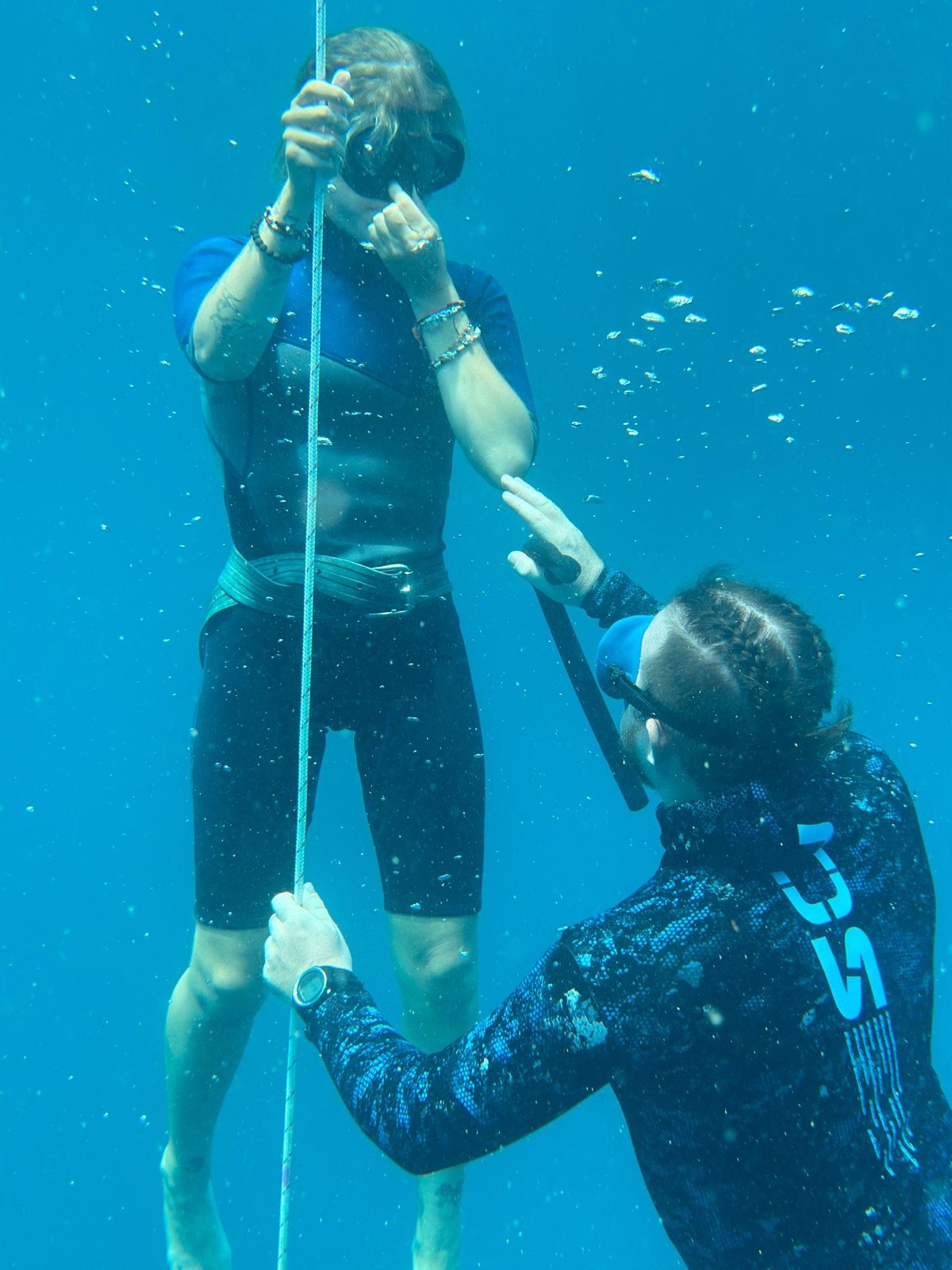
Short answer: a good freediving duck dive is one smooth, vertical fold from the surface into the dive — you bend at the hips, lift your legs straight up out of the water so their weight pushes you down, and you only start finning once your fins are fully submerged. Done right it costs almost no effort and points you straight down the line. Done wrong it is a thrashing, splashy mess that burns oxygen before you have descended a single metre. It is the most-overlooked skill in the whole sport, and it is also one of the quickest to fix once someone shows you what the body is supposed to do.
I watch new freedivers struggle with this constantly, and it is never because they are unfit. It is because nobody has ever told them that getting under the surface is a technique, not a scramble. So let me walk you through it the way I would standing next to you on the line.
Why the duck dive matters more than people think
The first few metres of any dive are the hardest. You are still positively buoyant — your full lungs and any wetsuit are trying to float you back to the surface — so this is the one part of the descent where you have to actively work against the water. A clean duck dive gets you down past that buoyant zone with the least possible effort, so that by the time you are finning you are already heading toward neutral and the water starts helping you instead of fighting you.
A sloppy duck dive does the opposite. If you slap at the surface, kick while your fins are still in the air, and drop in at an angle, you waste energy fighting your own buoyancy, you raise your heart rate right before a breath hold, and you arrive at depth already tired and already short of oxygen. The dive is half-ruined before it began. This is why we spend real time on it on a beginner course rather than treating it as an afterthought.
How a clean duck dive actually works
Break it into three movements and it becomes obvious:
- The fold. From a relaxed face-down float, you bend sharply at the hips so your upper body and arms point straight down toward the bottom. Reach down with your arms as if you are diving headfirst into the water — because that is exactly what you are doing.
- The legs. As your torso drops, you lift both legs straight up out of the water, keeping them together and pointed at the sky. The weight of your legs in the air now pushes your whole body downward, like a seesaw. This is the part people miss — the legs do most of the work, not the kicking.
- The first kick. Only when your fins are fully underwater do you take your first finning stroke. A fin kicking in the air moves nothing but spray. Wait, let the leg-weight pull you under, and then fin.
The whole thing should feel slow and deliberate, not explosive. You are not launching yourself down; you are folding into the water and letting gravity and your own weight do the early work.
The common mistakes I see every week
Almost every duck-dive problem is one of these:
- Kicking too early. The single most common error. The fins are still half in the air, so the kick achieves nothing except splashing and wasted effort. Patience is the fix — drop first, kick second.
- Not lifting the legs vertical. If your legs stay near the surface instead of pointing straight up, you lose all that helpful downward weight and you end up trying to muscle yourself under instead.
- Bending the knees. Bent knees waste the leverage. Long, straight legs act like a lever; bent legs act like nothing.
- Diving at an angle. If you fold off to the side, you end up swimming diagonally and missing the line, which means more distance, more kicks, and more oxygen burned. Aim straight down.
- Rushing the breathe-up to get under. A duck dive done in a hurry usually means the breathe-up was rushed too. Good descents start before you fold — they start with a calm, full final breath, the kind we cover in breathing techniques for beginners.
Equalisation starts at the duck dive
Here is something that surprises beginners: the duck dive is also where your first equalisation should happen. The pressure starts changing the moment your head drops below the surface, so you want to equalise early and often — your first one right as you fold under, before you feel any pressure at all. If you wait until your ears hurt, you are already behind. A clean, controlled duck dive gives you the calm and the time to do this properly. If equalising still feels like a fight, read how to equalise when freediving — getting that gentle and automatic changes everything about how the first ten metres feel.
Practise it slowly, and always with a buddy
The fastest way to improve a duck dive is to do it slowly and deliberately rather than forcefully. Speed comes from efficiency, not from effort — once the movement is clean, you barely have to try. And like everything in freediving, you practise it with a buddy watching, one person diving while the other supervises. The buddy system is not optional, and it never becomes optional no matter how good your duck dive gets.
If you want to feel the difference a proper technique makes, the easiest place to start is in the water with someone correcting you in real time — you will fix in one session what you would spend months getting wrong alone. The Discovery experience is a single supervised day to try it, and the beginner freediving course gives you the full technique and a certification you keep for life. Message me if you want to talk through which one fits you — I am always happy to answer honest questions before you commit.
About Diego Pauel
Diego has been teaching freediving from Koh Samui since 2021. He holds instructor certification from Apnea Total and additional credentials across six certification bodies: Oxygen Advantage, Breatheology, International Breathwork Foundation (IBF), Breathing Cold, and GPBA. Plus emergency oxygen administration and first aid.
Learn More →Ready to try freediving?
Message Diego on WhatsApp to check availability for your dates. No deposit needed.
Check Availability on WhatsAppContinue reading
How to Equalize When Freediving
A practical guide to equalization for freedivers. Learn the Frenzel technique, common mistakes, how to practice on land,
Read More →
How Long Does It Take to Learn Freediving?
How long it takes to learn freediving, certification by certification. Realistic timelines for first breath hold, Level
Read More →
Frenzel Equalization Explained Simply
Learn Frenzel equalization for freediving. Step by step dry exercises, common mistakes, and why this technique lets you
Read More →