How Long Does It Take to Learn Freediving?
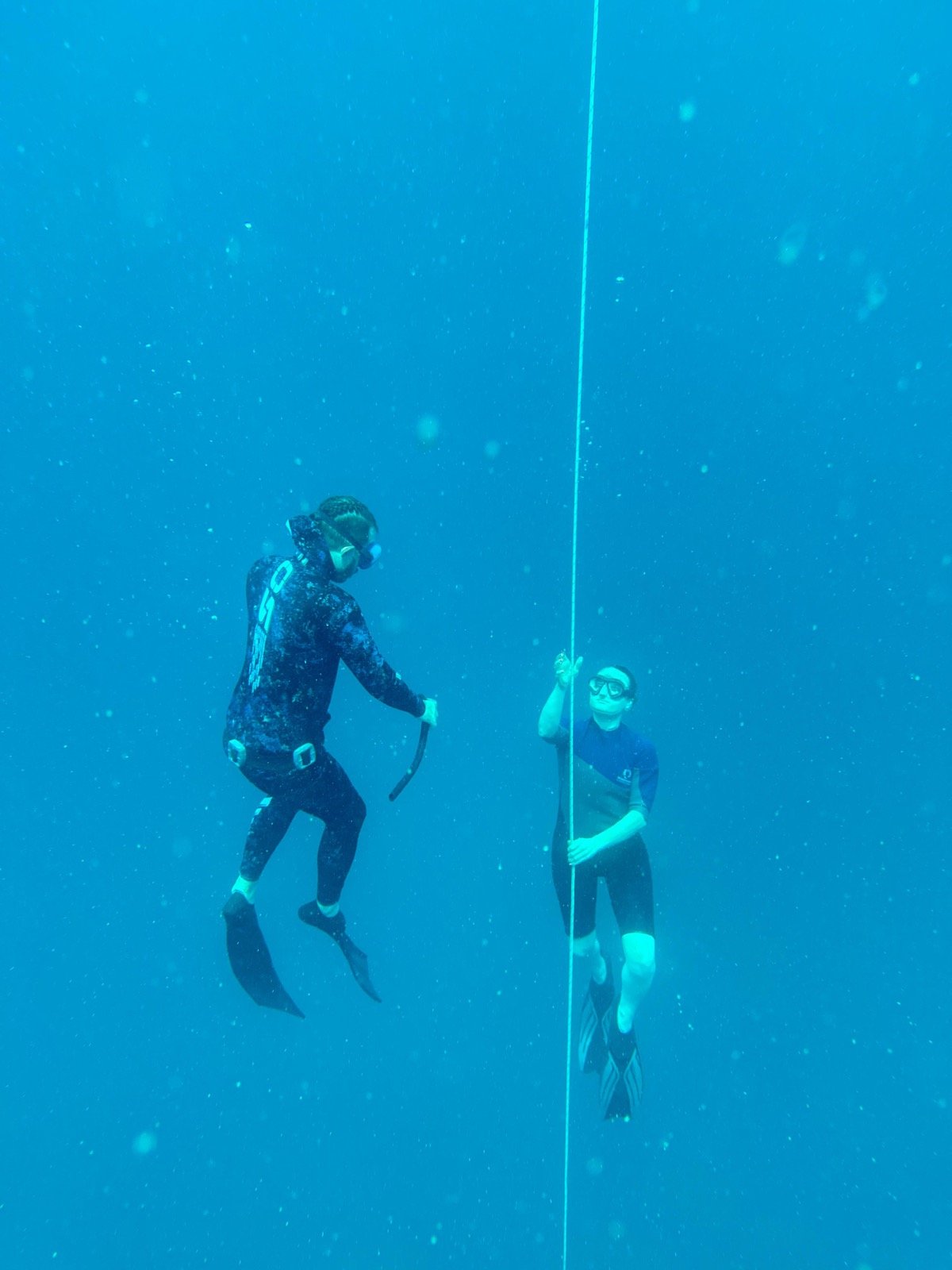
The short answer is three days.
Three days gets you a recognised international certification, a first open water dive to 15 or 20 meters, a working understanding of how breath hold physiology actually behaves, and safe buddy protocols that let you dive with other certified freedivers anywhere in the world.
The longer answer is that getting certified and becoming a good freediver are two different things. Certification is the start. Comfort at depth, reliable equalization, a relaxed static apnea over two minutes, and the kind of water confidence that lets you enjoy Sail Rock rather than survive it, that takes months of practice after the course ends.
Here is what the timeline actually looks like, milestone by milestone.
The Short Answer by Milestone
If you have never held your breath underwater before, this is roughly what to expect:
- First open water dive past 5 meters: Day 1 afternoon of a 3 day course.
- First dive past 10 meters: Day 2 morning of Level 1.
- Level 1 certification and 15 to 20 meter depth: End of Day 3. Three days total.
- Comfortable at 20 meters on fun dives: First few weeks of regular practice after the course.
- Level 2 certification and 30 meter depth: Another 3 days, typically taken a few weeks to several months after Level 1.
- Confident recreational freediver at 35 to 40 meters: Three to six months of consistent practice after Level 2.
- Advanced amateur at 50 meters or more: One to two years of focused training, including regular depth sessions and dry training.
Most recreational freedivers never go past 30 to 40 meters and do not need to. That is already a depth where you can access incredible dive sites, hover with pelagic fish, and move through the water with the kind of quiet grace that first drew you to freediving.
What Level 1 Gives You in 3 Days
Level 1 is the gateway. At Freediving Koh Samui, that course runs Monday through Wednesday with a maximum of three students per instructor. Here is what those three days cover.
Day 1: Theory and First Water Session
The morning is theory. You learn how breath hold physiology works: the mammalian dive reflex, oxygen management, the difference between hypoxia and hypercapnia, and why relaxation produces longer breath holds than muscle power. You learn equalization methods, starting with the Valsalva technique most people already know from swimming, then moving toward the Frenzel technique that freedivers rely on. You learn safety protocols. Buddy systems, blackout response, the five minute rule.
The afternoon is pool work or confined water. You practice static apnea at the surface to calibrate your own tolerance. Most beginners who have never trained hold their breath for 45 to 90 seconds on the first try and 2 minutes by the end of the day. You also practice dynamic apnea, swimming a distance underwater with one breath, which teaches efficient finning and relaxation under movement.
By the end of Day 1 you have usually done your first few descents in open water at depths of 5 to 10 meters. Nothing scary, fully supervised, often at sheltered sites around the south of Koh Samui.
Day 2: Depth Progression
Day 2 is a full boat day. You work on the descent line at progressively deeper stops, starting at 10 meters and moving toward 15. You spend time between dives recovering, observing other students, and learning to read your own body.
Most Level 1 students reach 15 meters on Day 2 with clean equalization. The stopping points are almost never physical. You have the breath hold capacity. The limit is usually equalization comfort, and equalization comfort improves with practice more than with force.
You also start learning the finer points of relaxation at depth. Mouth position, tongue technique, the subtle mental shift that separates people who free fall calmly past 10 meters from people who fight the water the whole way down.
Day 3: Certification and Open Water Graduation
Day 3 is your certification dive. You complete the skills needed for the Apnea Total Level 1 card, which is equivalent to AIDA 2 or SSI Level 1. That means a static apnea around 2 minutes, a dynamic apnea around 40 meters, and a constant weight dive to at least 16 meters with clean technique.
Most students go further. Reaching 18 to 22 meters on the Day 3 dive is common when conditions and equalization cooperate. Some push to 24 or 25.
You leave Day 3 with a recognised certification, the skills to dive with other certified freedivers, and a clear understanding of what you still need to work on. That last part matters more than the card.
What Level 2 Adds
Level 2 is another 3 day course. Most students wait weeks or months between the two. Some take them back to back.
The biggest skill jump is the mouthfill equalization technique. At depths past 20 meters, the standard Frenzel technique starts to run out of air as your lungs compress. Mouthfill lets you store air in your cheeks and use it to equalize at depths where Frenzel alone cannot keep up. Without it, you hit a ceiling around 20 to 25 meters. With it, the door opens to 30 meters and beyond.
Level 2 also covers rescue protocols in more detail. Surface blackout recovery, deep water assist, and managing a dive emergency from the descent line. The safety work is not paranoid. It is the thing that lets you dive with confidence because you know the plan if something goes wrong.
By the end of Level 2, most students reach 24 to 30 meters. You earn the Apnea Total Level 2 card, equivalent to AIDA 3 or SSI Level 2. That certification opens the door to guided fun dives at the best sites in the region, including Sail Rock depth training.
For depth expectations at each level, we wrote a full breakdown in How Deep Can a Beginner Freedive?
The Gap Between Certified and Comfortable
Here is the part most marketing leaves out. A certification card does not mean you are a good freediver. It means you passed a test on a specific day with a specific instructor.
Most students finish Level 1 and realise they did things in the course they cannot yet reliably do on their own. They hit 20 meters under supervision but feel tense at 12 meters the first time they dive without their instructor next to them. They held a 2 minute static under structured conditions but cannot relax into a clean breath hold when there is nobody counting.
This is normal. It is also the work that separates people who freedive once on holiday from people who become freedivers.
The gap closes in the months after your course. Here is a rough timeline if you train consistently:
- Weeks 1 to 4 post course: You revisit the skills on your own or with a local buddy. Static apnea in a pool. Dry breath holds while sitting on a couch. Short fun dives at sheltered sites. The aim is not to progress, it is to make the existing skills feel like yours.
- Months 2 to 3: You start extending your comfort zone. Depth dives to 20 meters feel routine. You begin experimenting with mouthfill on your own if you have Level 2. Static times stretch past 2 minutes 30 seconds.
- Months 4 to 6: You can self manage a dive session with a qualified buddy. Your depth ceiling moves from 20 to 30 plus meters depending on how much water time you have logged.
- Year 1 to 2: You are a proficient recreational freediver. You travel to freediving destinations and can join guided fun dives anywhere without needing hand holding. Your depth limit is your training volume, not your certification level.
What Slows People Down
Not everyone progresses at the same rate. Here is what most commonly slows students down and what usually fixes it.
Equalization struggles
By far the most common bottleneck. About half of beginners hit some kind of equalization resistance in their first course, either because they have never consciously equalized before or because their Frenzel technique has not locked in yet. The fix is dry training. Fifteen minutes a day practicing Frenzel on land, with no water pressure, builds the muscular coordination faster than pool sessions alone. We covered the mechanics in detail in How to Equalize When Freediving.
Stress response under water
Some people carry a physiological alarm response into the water. Their heart rate climbs instead of drops, their breath hold capacity halves, and they cut dives short. This is not weakness or lack of fitness. It is the nervous system needing time to learn that descending calmly is safe. The fix is repetition in friendly conditions. Warm water, small groups, low pressure dive profiles for the first few weeks. Koh Samui water temperature around 29 degrees and the sheltered sites we use for early training are ideal for this.
Infrequent practice
Students who take Level 1 on holiday and then do not touch freediving for a year lose most of what they built. Three weeks of casual practice after the course preserves more skill than one intense month a year later. Dry statics, breath work, and pool sessions are all available in most cities. You do not need open water to keep the skill alive.
Physiology
A small number of people genuinely take longer. Narrow sinus passages, reactive airways, or a resistant middle ear can slow equalization progression. Almost all of these are manageable with technique adjustments and patience. None of them are disqualifying for recreational freediving.
Realistic Student Timelines
Here are three patterns we actually see at Freediving Koh Samui.
The one time traveller
Books Level 1, completes the 3 day course, reaches 18 meters, returns to an office job and does not freedive again for two years. The certification stays valid but the skills fade quickly. When they return for a refresher, they need one day in the pool and one day at depth to recover the core skills.
The committed hobbyist
Takes Level 1 on holiday, returns home and joins a local freediving pool session once a month. Does occasional dry statics at home. Returns to Koh Samui a year later for Level 2. Reaches 25 meters on Day 3 of the new course without a refresher day needed, because the base skills have been maintained.
The serious amateur
Does Level 1 and Level 2 in the same trip or within a few months of each other. Trains twice a week at home between trips. Comes back for a 5 to 7 day fun dive trip and reaches 35 to 40 meters routinely. Often starts looking at freediving coaching, competition lanes, or instructor level training within 18 months.
Most students fall somewhere between the first two. Very few start with the serious amateur trajectory and that is fine. Freediving is a practice that welcomes slow growth.
If You Are Already a Scuba Diver
Certified scuba divers usually pick up freediving faster than pure beginners. Water confidence is already there, mask and fin skills are already there, and the psychology of being submerged is familiar. What scuba divers often need to unlearn is constant breathing. Letting go of the regulator and accepting a single breath is harder than it sounds. Most scuba divers reach a good Level 1 result on schedule with no real struggle.
The physiology is different enough that we wrote a full comparison in Freediving vs Scuba Diving. If you have scuba experience and you are weighing whether to try freediving, read that first.
If You Come from Yoga or Breath Work
Students with existing breath work practice, yoga pranayama, Wim Hof method, Oxygen Advantage training, often find the breath hold aspect easier than average. The nervous system work is already there. What they sometimes underestimate is the water component, which is different from a dry breath hold on a yoga mat.
The combination of breath skill and water skill is what produces a comfortable freediver. Dry breath work gives you a head start but does not replace time in the water.
Frequently Asked Questions
Can I learn freediving in a weekend?
A 2 day course gives you AIDA 1 or similar entry level certification, but it is compressed. Most schools on Koh Tao run 2 day courses because students are passing through on a tighter schedule. The extra day in a 3 day format is used for more pool work, more safety practice, and more relaxed descent progression. People who take 3 day courses consistently finish with cleaner technique and deeper dives. If you only have 2 days, a 2 day course still teaches the fundamentals. If you can make 3 days, the extra time pays off.
How long before I can dive Sail Rock?
Certified freedivers can book fun dives at Sail Rock immediately after Level 1. The depth is up to you. Sail Rock has excellent shallow water around 5 to 15 meters full of marine life, and deeper sections at 25 to 35 meters for more experienced divers. Level 1 certification is enough to join a guided fun dive at Sail Rock on your very next trip.
Is there a minimum fitness level?
No. You need to be a comfortable swimmer in open water and generally healthy. No lung diseases, no uncontrolled cardiovascular conditions, no recent ear surgery. Fitness as defined by running pace or gym strength is not relevant. Relaxation matters more than fitness in freediving, and being overtrained in anaerobic sports can actually slow your progression.
Can I do Level 1 and Level 2 back to back?
Yes. Some students take both courses in a single 6 or 7 day trip. The benefit is momentum. The downside is that you miss the integration time between Level 1 and Level 2 that many students use to let the first set of skills become automatic. If you have a week on Koh Samui and you are motivated, back to back is a good option. Diego will adjust the pace of Level 2 to match what you carried out of Level 1.
How long does the certification last?
Apnea Total, AIDA, PADI, and SSI freediver certifications do not expire. The card is valid for life. What can fade is your skill level. If you have not dived for over a year, most schools including ours recommend a refresher dive or two before going back to your previous depth. A refresher is not a repeat course, it is an hour or two in the water to rebuild familiarity.
Is three months realistic to reach 30 meters?
Yes, if you have Level 2 and you train consistently. The people who reach 30 meters in three months tend to have taken Level 1 and Level 2 close together, kept a regular pool practice, and returned to open water at least twice during those three months. Without consistent practice the timeline stretches.
When to Start
The best time to start is usually the trip you have already planned. If you are coming to Koh Samui anyway, a 3 day course fits easily into a week and leaves the other four days for recovery, beaches, and everything else that makes Samui a good island.
If you are choosing between schools, do not pick on price alone. Small group size, a skilled instructor, and good dive sites matter more than the lowest rate. We wrote about this tradeoff in Best Freediving School in the Gulf of Thailand.
Our Beginner Freediving Course runs every Monday to Wednesday with a maximum of three students. Emergency oxygen is on every boat. The Advanced Course runs Tuesday to Thursday. Both courses train at Sail Rock and the sheltered sites around the south coast.
If you want to talk through your situation, message Diego on WhatsApp. Tell him what you want from the course, how much time you have, and any previous water experience. No deposit required until you confirm the week you want to dive.
About Diego Pauel
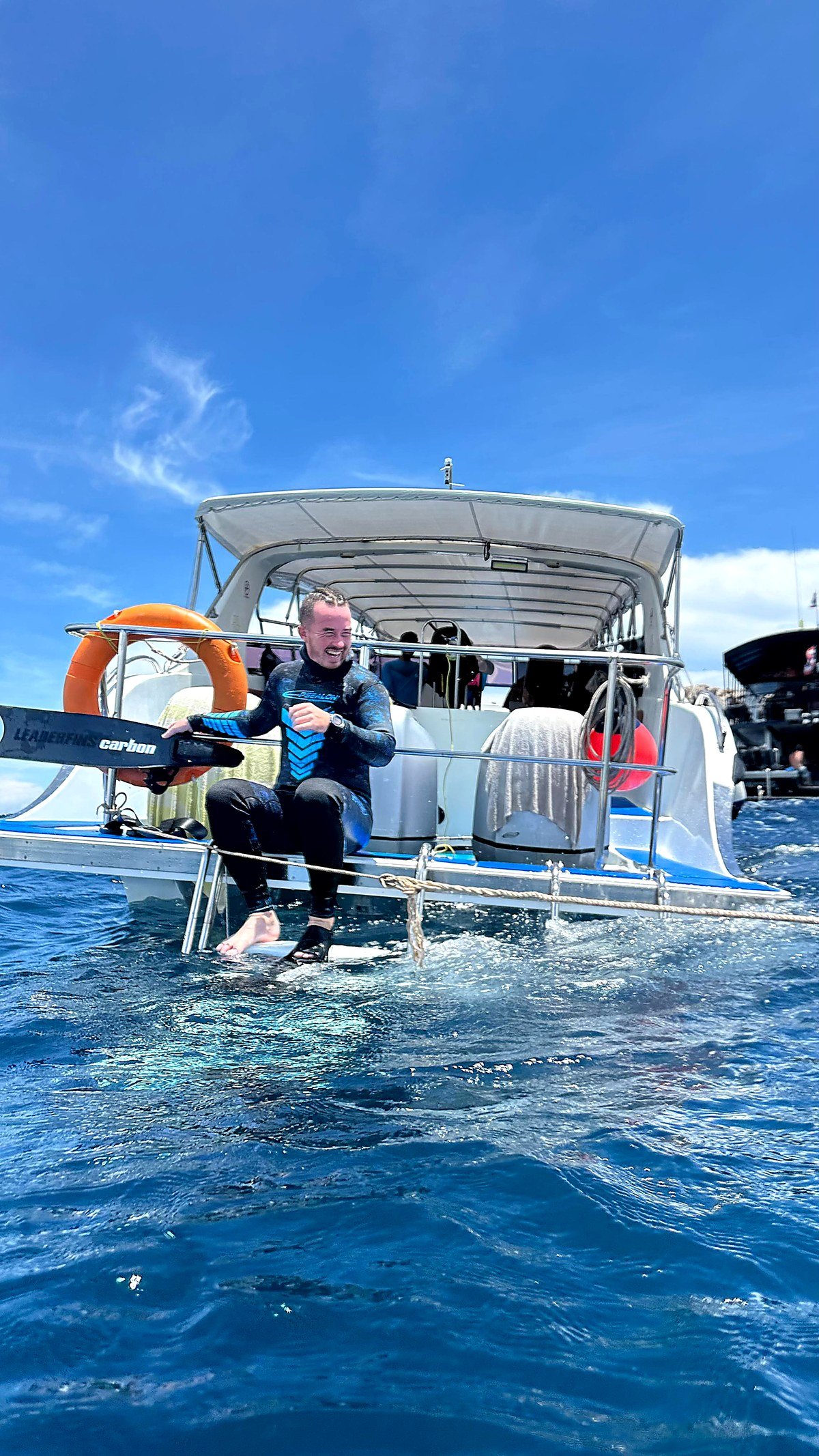
Diego has been teaching freediving from Koh Samui since 2021. He holds instructor certification from Apnea Total and additional credentials across six certification bodies: Oxygen Advantage, Breatheology, International Breathwork Foundation (IBF), Breathing Cold, and GPBA. Plus emergency oxygen administration and first aid.
Learn More →Ready to try freediving?
Message Diego on WhatsApp to check availability for your dates. No deposit needed.
Check Availability on WhatsAppContinue reading
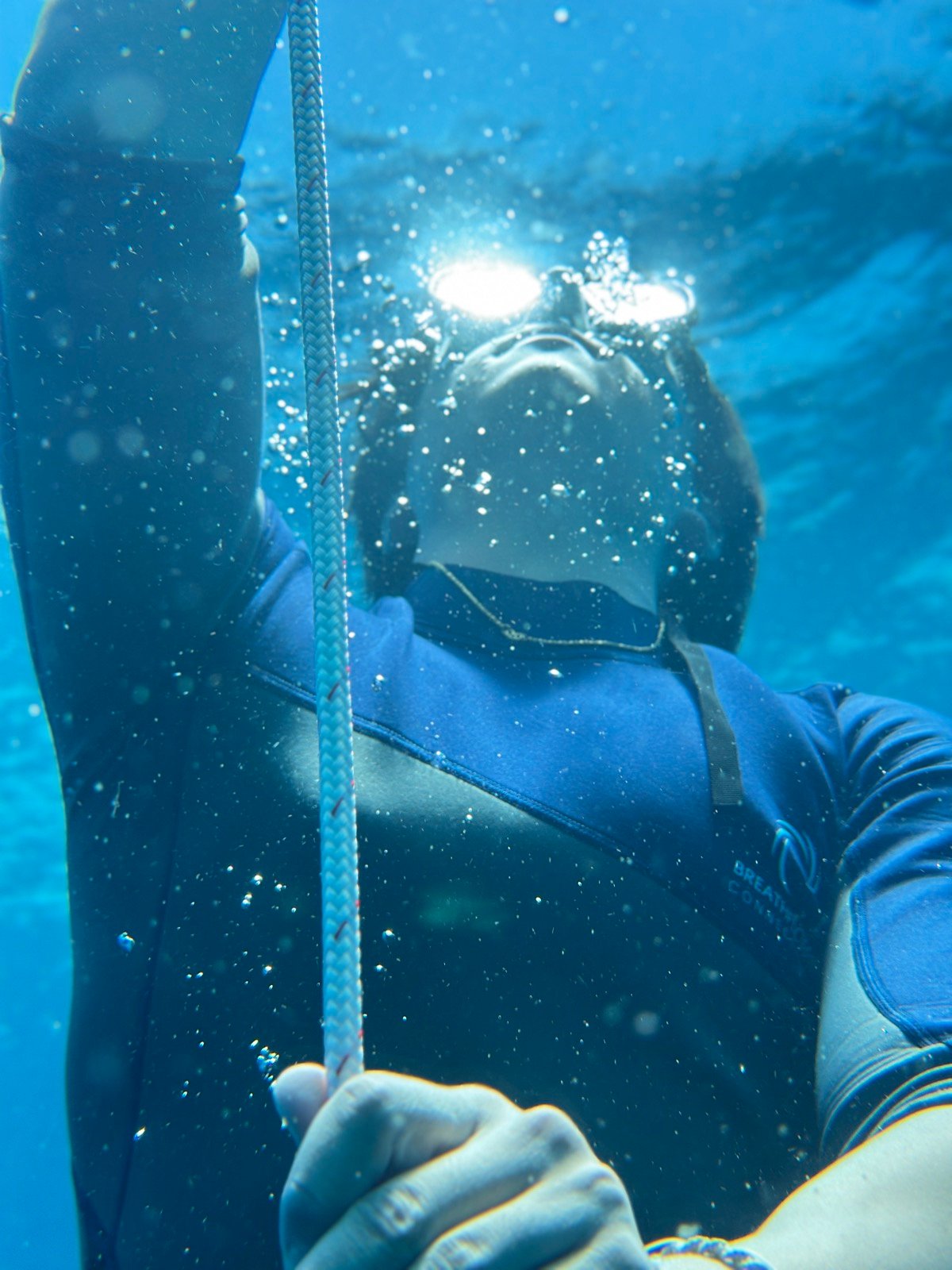
Frenzel Equalization Explained Simply
Learn Frenzel equalization for freediving. Step by step dry exercises, common mistakes, and why this technique lets you
Read More →
Freediving Finning Technique: How to Kick From the Hip and Stop Wasting Oxygen
Most beginners burn through their breath hold by kicking wrong — bending the knees, kicking too hard, and fighting the
Read More →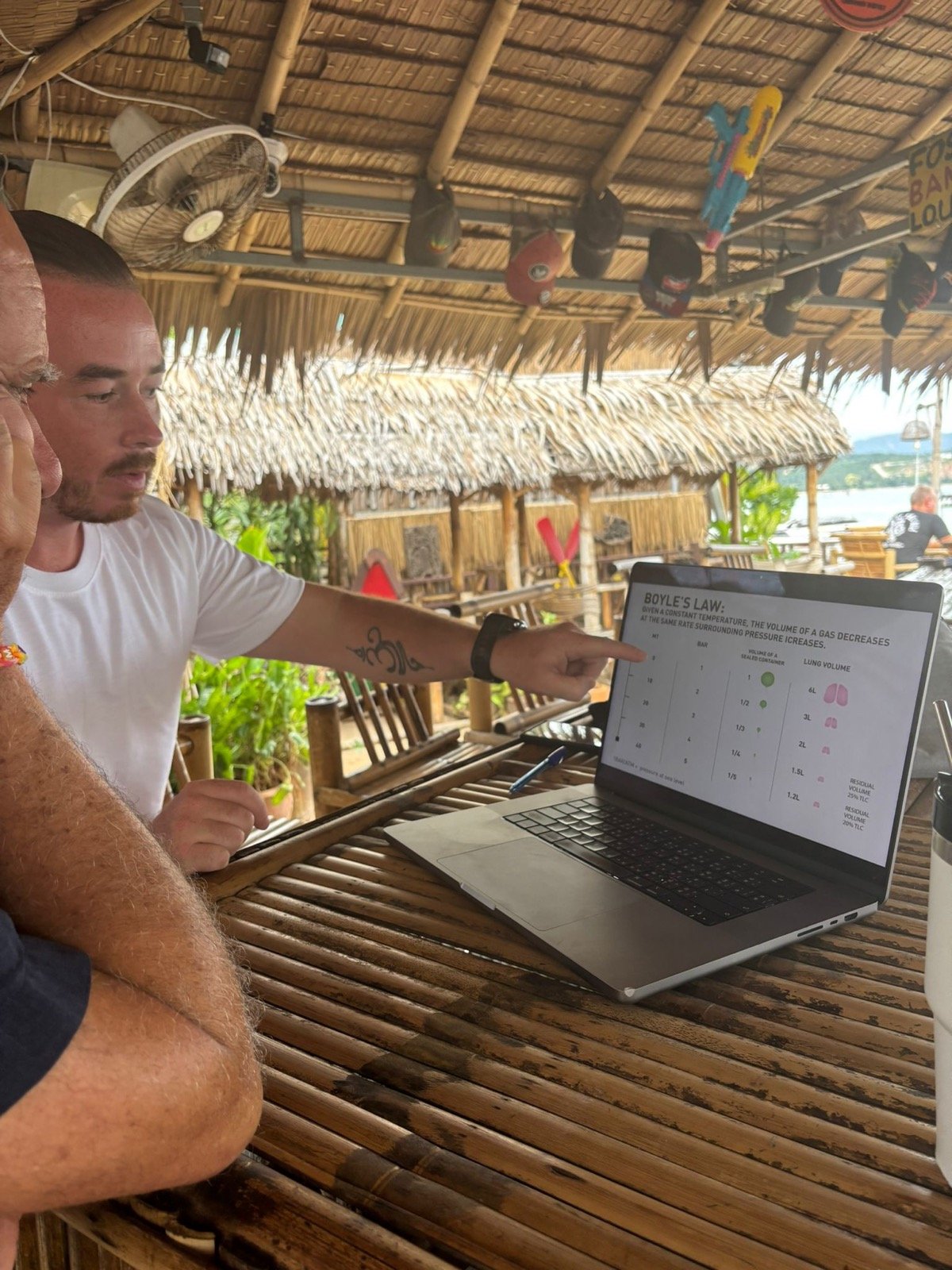
Why You Can't Equalize Freediving — and How to Fix It
Can't equalize when freediving? An honest fix-it guide from a Koh Samui instructor. The most common reasons your ears wo
Read More →