Overcoming the Fear of Deep or Dark Water in Freediving
Short answer: being afraid of deep or dark water is completely normal — almost every freediver felt it at the start, including me. It is not a sign you are unsuited to the sport; it is your survival instinct doing its job. The fear fades not by forcing yourself through it but by removing the unknowns one at a time: a line you can always hold, a coach right beside you, and a pace you set yourself. Done that way, the deep stops feeling like a void and starts feeling like somewhere you belong. Let me talk about this honestly, because it is one of the most common things people are too embarrassed to admit before a course.
People think they need to arrive fearless. They don't. The fear of looking down into deep blue or dark water, of not being able to see the bottom, of being far from the surface — that is one of the most human reactions there is. If anything, a healthy respect for the water makes you a better, safer diver. The goal is never to delete the fear. It is to understand it and put it in its place.
Why the fear is normal — and useful
Your brain is wired to be cautious about deep, open, dark water. For most of human history that caution kept people alive. So when you look down a line that disappears into blue and feel your stomach tighten, that is not weakness — that is a very old, very sensible part of you paying attention.
The problem is only when that fear runs the show: when it becomes panic, tension, rushed breathing, and pushing or grabbing. A tense, frightened freediver burns oxygen faster and equalises worse. So the work is not to be fearless — it is to stay relaxed while a bit of fear hums in the background. That is a learnable skill, and the whole structure of a course is built to teach it. I wrote more about this in my post on the five fears every beginner has, and fear of the deep underlies nearly all of them.
How a line removes the unknown
Most fear of deep water is really fear of the unknown — not knowing how deep you are, whether you can get back, or what is below you. The dive line answers all of that.
- You always know where you are. The line is marked. You can see and feel exactly how deep you have gone, so the depth is never a mystery.
- You always have a way back. The line is your road home. You are never swimming off into open water hoping to find the surface — you follow the rope up, the way you came down.
- You can hold it any time. A lanyard connects you to the line, and you can pause, stop, or turn around whenever you want. Nothing forces you deeper.
- It gives you a focus. Instead of staring into the void below, your attention is on the line, your equalising, your relaxation. The "scary" empty water stops being the thing you are looking at.
The dark or low-visibility days are the same story. A line in murky water still tells you exactly where you are and exactly how to get back. The unknown is what frightens people. The line turns the unknown into a known.
How a coach beside you removes the rest
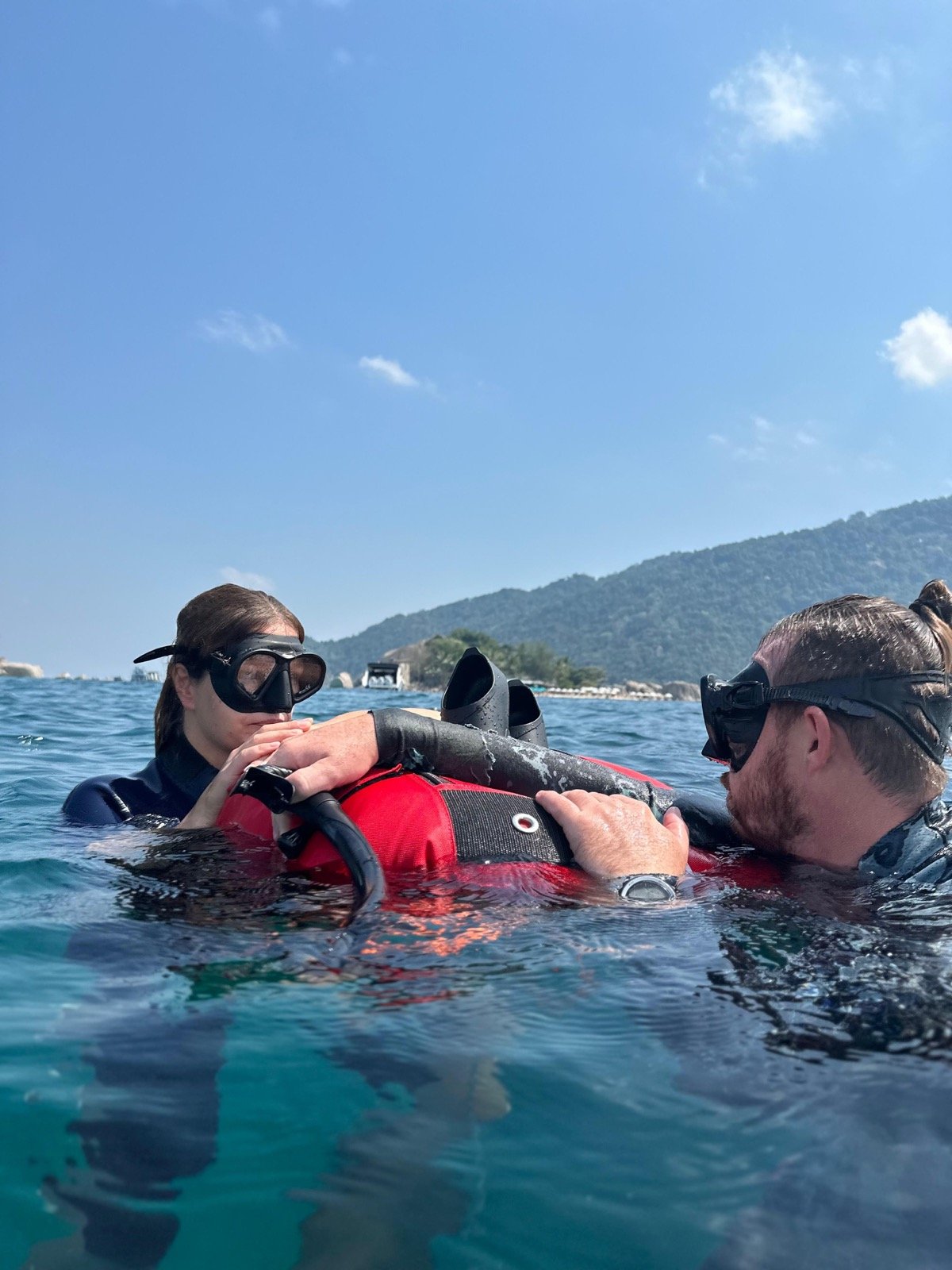
The other half of the fear is being alone with it. So you are not. On every descent that matters, I am right there with you — and this is also the safety rule that never bends: one up, one down, and you never freedive alone. You always have someone whose entire job in that moment is you.
Having a coach beside you changes the experience completely. You are not testing yourself against the deep in isolation; you are doing something supported, watched, and shared. If your breathing gets quick, I see it and we slow down. If your eyes look rushed before a dive, we stop and reset. You learn to read your own fear with someone who has seen it a thousand times standing next to you. That is the difference between fighting the fear alone and dissolving it with help. You can read exactly how that safety works in my post on the freediving safety system.
Going at your own pace
This is the part I want you to really hear: there is no depth you have to reach. Not on my courses. If you equalise comfortably to six metres today, six metres is your dive. Tomorrow we might try eight. There is no quota, no comparison to the student next to you, no instructor pushing you past where you feel safe. Pushing is exactly what creates panic and risk — so we do the opposite.
What happens, almost every time, is that the fear shrinks faster than people expect. The first time you hang on the line at ten metres, relaxed, looking back up at the light, something clicks. The deep stops being a threat and starts being peaceful. Most students describe their best dives not as exciting but as the calmest they have ever felt. That calm is on the other side of the fear — and the only way there is gently, at your pace, with support.
Where to start
If the fear of deep water is the thing holding you back, the answer is not to wait until you feel braver. It is to start in the most supported way possible. The Discovery experience is a single day in the water with me, no pressure, no depth target — just you, the line, and a coach, getting comfortable. If you are ready to build the full skill set and turn that fear into competence, the beginner freediving course takes you there step by step over a few days.
And if you are still on the fence, message me and tell me honestly what scares you. I promise I have heard it before, and I would much rather talk it through than have you write off something you might genuinely love.
About Diego Pauel
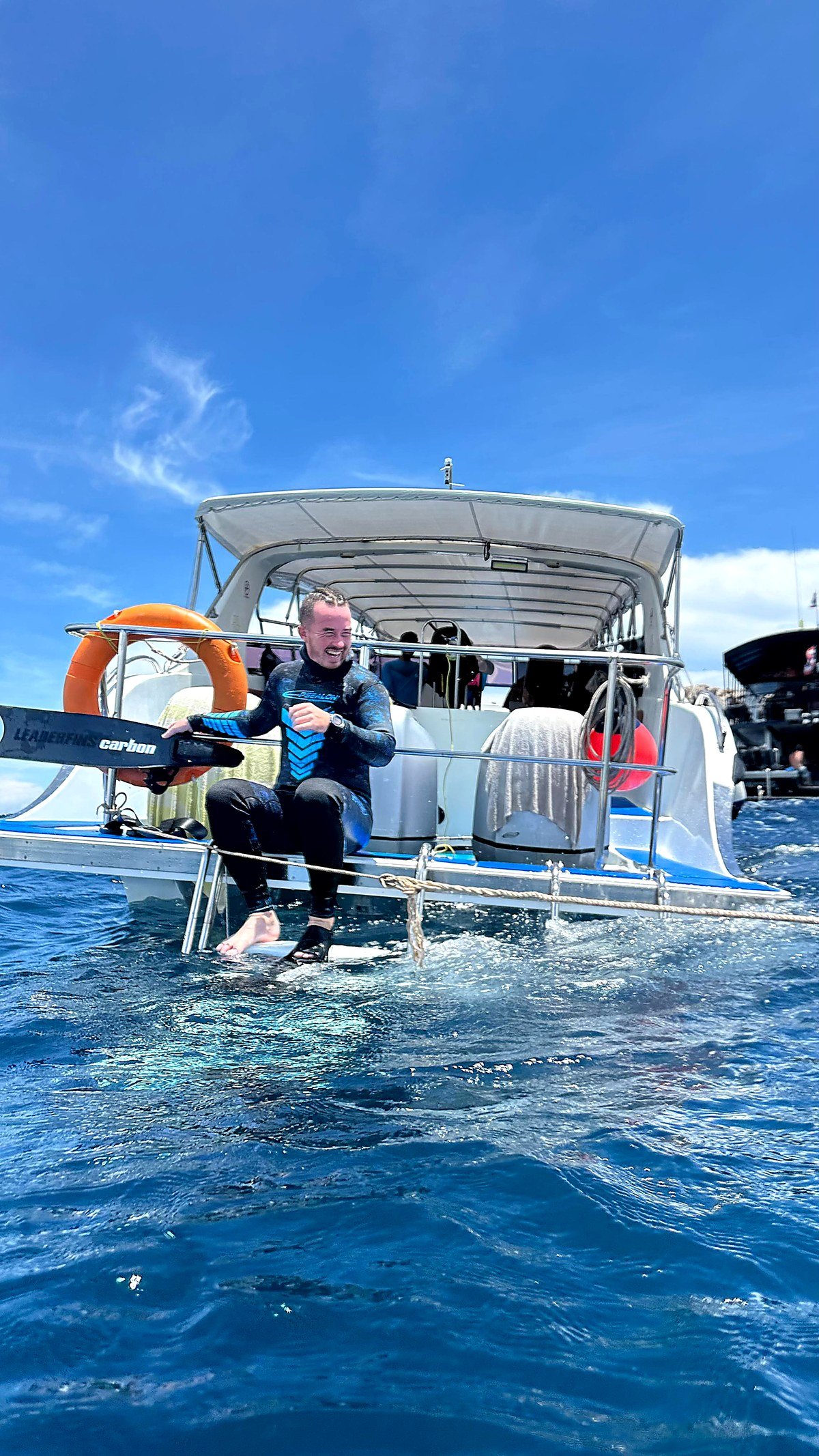
Diego has been teaching freediving from Koh Samui since 2021. He holds instructor certification from Apnea Total and additional credentials across six certification bodies: Oxygen Advantage, Breatheology, International Breathwork Foundation (IBF), Breathing Cold, and GPBA. Plus emergency oxygen administration and first aid.
Learn More →Ready to try freediving?
Message Diego on WhatsApp to check availability for your dates. No deposit needed.
Check Availability on WhatsAppContinue reading
Can You Freedive with a Cold?
The honest answer to whether you can freedive with a cold, congestion, or sinus issues. What the risks are, when it is s
Read More →
Shallow Water Blackout and Samba in Freediving, Explained
What are shallow water blackout and samba in freediving? An honest explanation from a Koh Samui instructor: why they hap
Read More →
Is Freediving Safe? What You Need to Know
Is freediving safe? An honest look at the real risks, how proper training eliminates most of them, and what safety proto
Read More →